
Business losing profitability:
Sales are growing. Orders are coming in, and production is busy.
But at the end of the month, profit doesn’t seem to reflect the level of business you are doing.
I have seen this situation in many businesses.
The immediate reaction is often to cut costs. Management starts questioning manpower, overtime, consumables, travel and other expenses.
But before asking “Where can we cut costs?”, I believe there is a more fundamental question:
Where is the business actually losing profit?
One practical way to answer this is to look at the economics of your business value chain.
Not as a management concept, but through a very simple business question:
Where is the money going?
Start with the economics of your business
Every business has a different cost structure.
In one manufacturing company, raw material may be the dominant cost. In another, conversion cost may be high. Somewhere else, poor capacity utilisation, rejection, rework, inventory, logistics or finance costs may be affecting profitability.
That is why looking only at sales growth isn’t enough.
A founder or business head should broadly understand how the selling price is distributed across the business before anything remains as profit.
How value gets distributed across a product
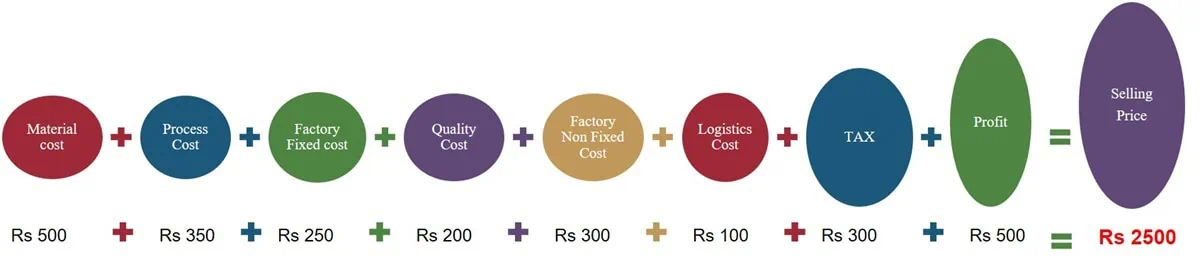
The ₹2,500 example above gives a simple picture of how a product’s selling price gets distributed across raw materials, processing, factory costs, quality, logistics, taxes, and other costs before anything remains as profit.
The purpose is not to calculate every cost perfectly at this stage.
It is to understand the business’s economic structure.
Once you start looking at the business this way, the discussion changes.
Instead of asking:
“Where can we reduce expenses?”
you start asking:
“Which part of our value chain has the greatest influence on our profitability?”
That is a much better starting point.
Look at every ₹100 of sales.
I find another simple way of looking at the same question useful when working with business leaders.
Take your total sales as ₹100.
Now ask:
Where does every ₹100 of sales go?
Illustrative example only. The cost structure will be different for every business.
The actual numbers will obviously be different for every company.
That is precisely the point.
You need to know your numbers.
If the founder and leadership team understand where every ₹100 of sales is going, they can start seeing where the real profitability opportunities are.
Regular P&L reviews can help founders spot which cost percentages are moving and where management needs to investigate further.
One number told us where to start.
In one sheet-metal manufacturing company I worked with, the CEO told me that raw material cost was around 83% of sales.
That number told us where to look.
If ₹83 out of every ₹100 of sales was already being consumed by material, and another 12% or so was required for labour and other operating costs, there was hardly enough room left for the company to make a reasonable profit.
We did not start cost-reduction initiatives everywhere.
We started with the biggest opportunity.
Since this was a sheet-metal business, we went deeper into the material-cost structure and worked systematically on:
- raw material cost reduction
- alternative sourcing
- inventory reduction
- yield improvement
- better material utilisation
Over about a year, raw material cost fell from around 83% of sales to 67%.
That was a significant improvement in the business economics.
But the bigger learning wasn’t simply that material cost came down.
Understanding the value chain helped us identify where the biggest profitability opportunity was and therefore where management attention had to go first.
Not every cost deserves equal attention.
This is where I see many improvement efforts losing focus.
Management may spend considerable time trying to control relatively small expenses while a much larger cost driver remains insufficiently challenged.
Imagine material cost represents 65% of sales while another expense represents only 2%.
Even a small percentage improvement in material economics can potentially create a much greater financial impact than a significant percentage reduction in the smaller expense.
This does not mean smaller expenses should be ignored.
It means:
Management attention should match business impact.
The value-chain view helps establish that priority.
Where could your profit be leaking?
Once you understand the business’s broad economics, go one level deeper.
Profitability can be lost at several points in the value chain.
The important thing is to identify which ones matter most in your business.
Raw material
If material is your highest cost, don’t stop at the purchase price.
Look deeper into:
- sourcing and supplier alternatives
- purchase price
- material specifications
- yield and utilisation
- scrap
- rejection and rework
- nesting or cutting efficiency
- minimum order quantities
- excess inventory
- obsolete and slow-moving material
A purchase-price reduction is only one way of improving material economics.
Sometimes the bigger opportunity is hidden in how effectively the material is being used.
Our sheet-metal example illustrates this well. The improvement did not come from one action. It came from looking at the full material-cost structure and improving several drivers at once.
Conversion and capacity
A company may have reasonable material cost but still lose profitability through poor conversion efficiency.
Look at productivity, machine utilisation, bottlenecks, cycle time, changeovers, downtime, overtime and overall capacity utilisation.
A machine running throughout the day does not necessarily mean the asset is being used productively.
Overall Equipment Effectiveness can help identify where productive capacity is being lost.
Poor utilisation also creates another problem.
As sales grow, management may conclude that additional machines or capacity are required when the first opportunity may actually be to improve the utilisation of existing capacity.
I have seen this very clearly in manufacturing businesses. In one case, strengthening operational performance helped the organisation increase OEE substantially and grow without the additional equipment that had initially appeared necessary. My article on building delivery capabilities in a growing manufacturing business explains the broader principles.
Quality
Quality losses are often underestimated because they appear in different places.
Rejection is visible.
But what about rework, sorting, additional inspection, lost machine time, line stoppages, premium freight, customer complaints, warranty costs, and management time?
These costs may not appear together in one report.
The actual cost of poor quality can therefore be much higher than the rejection percentage visible in the monthly review.
Inventory and working capital
Inventory may not immediately look like a profitability issue.
But excess raw material, work in progress, and finished goods tie up cash, consume space, increase handling, create obsolescence risk, and increase financing requirements.
I have seen businesses growing in sales while simultaneously putting more and more money into inventory.
Growth then starts consuming cash rather than generating it.
That is why inventory should not be seen only as an operational measure.
It is also an important part of tbusiness’s economicsess.
If your organisation carries significant inventory and still struggles with customer delivery, the issue may lie deeper in planning and execution. I have discussed this in detail in Why Do We Have So Much Inventory and Still Miss Deliveries?
Logistics and supply chain
Poor planning can create costs that management gradually starts accepting as normal. Examples include premium freight, emergency purchases, small-lot transportation, unnecessary material movement, and repeated schedule changes.
Individually, some of these costs may appear small.
When they become a regular way of working, their accumulated impact can become significant.
The question therefore is not simply:
“How much are we spending on logistics?”
It is also:
“How much of this cost is being created because of the way we plan and execute the business?”
Customer and product mix
This is another area business leaders should look at carefully.
Not every rupee of sales contributes equally to profit.
A large customer may bring significant sales but may also demand lower prices, smaller batches, special inventory, longer credit, frequent schedule changes, additional quality requirements or disproportionate management attention.
Similarly, two products with similar selling prices can have very different cost structures and contribution levels.
This is why sales growth alone cannot tell us whether the business is becoming better.
Management needs to understand which customers and products are actually creating value for the business.
Overheads and finance costs
As businesses grow, overheads also tend to grow.
People are added. Systems are added. Facilities expand. Management layers increase.
Some of these investments are necessary for growth.
The question is whether overheads are rising because the business is genuinely building organisational capability or because complexity and inefficiency are gradually creeping in.
Finance cost also deserves attention.
If growth continuously requires higher inventory, longer receivables and more borrowing, part of the additional margin may eventually disappear through financing costs.
This is why profitability and cash flow cannot be looked at separately.
Do not look only for cost reduction
There is an important distinction here.
The purpose of understanding the value chain is not to reduce every cost.
That can become dangerous.
Reducing supplier cost at the expense of quality, reducing inventory without improving planning, cutting manpower without improving productivity or postponing necessary capability investments may improve numbers temporarily while weakening the business.
The objective is different.
Understand where value is created, where value is lost and where management intervention can create the greatest business impact.
Sometimes the answer will be cost reduction.
At other times, the opportunity may come from:
- improving yield
- increasing productivity
- improving capacity utilisation
- reducing inventory
- improving customer or product mix
- changing sourcing
- improving pricing
- reducing working capital
- eliminating non-value-added activities
- improving delivery reliability
This is why I see value-chain thinking as a profitability improvement approach, not merely a cost-reduction exercise.
Start with the P&L, but do not stop there
Your monthly P&L can tell you what has happened.
Material cost increased.
Gross margin reduced.
Employee cost increased.
Finance cost went up.
Profitability declined.
These are important signals.
But the P&L alone may not tell you why.
Suppose material cost has moved from 65% to 69% of sales.
Management needs to go behind that number.
- Was purchase price higher?
- Did the product mix change?
- Was yield lower?
- Did scrap increase?
- Was rejection higher?
- Were smaller quantities purchased at higher prices?
- Did customer pricing fail to absorb increases in material cost?
This is where financial review needs to connect with operational review.
The number identifies the signal. The value chain helps you investigate the cause.
This is also why I encourage founders and business heads to use the monthly P&L as a management tool rather than treating it only as an accounting statement.
Do not try to improve everything at once
Once management starts analysing the value chain, it is easy to identify many opportunities.
That creates another risk.
Too many initiatives get launched simultaneously.
Material reduction. Inventory reduction. Productivity. Quality. Logistics. Receivables. Cost control.
Everyone becomes busy, but the business impact may remain unclear.
I prefer a more disciplined approach.
- Identify the two or three biggest profitability opportunities.
- Understand the root causes.
- Assign clear ownership.
- Set a measurable target.
- Review progress consistently.
- Verify whether the improvement is actually appearing in the financial results.
That is how operational improvement gets connected to business performance.
What should a founder or business head review?
I don’t believe the person leading the business needs to get involved in every cost line or operational detail.
That itself can create unnecessary dependency.
But the founder and leadership team should periodically understand a few fundamental questions:
Where does every ₹100 of sales go?
Which two or three elements have the biggest influence on our profitability?
How have those percentages changed over the last 12 months?
Why have they changed?
Where are we losing value today?
Which improvement opportunities can create the greatest impact?
Are those improvements actually showing up in the P&L and cash flow?
That last question is particularly important.
An improvement project is not complete simply because an activity has been implemented.
Ultimately, the improvement should translate into a measurable business result.
From value-chain understanding to profitable growth
Growth should make a business more profitable, not simply bigger.
That requires more than increasing sales.
The organisation needs the capability to understand its economics, identify key business drivers, prioritise improvement opportunities,s and execute them consistently.
This is also an important part of my Profitable Growth Capability Framework (PGCF).
Within Business Execution Capability, financial discipline, operational performance, supply-chain effectiveness, customer profitability and management review cannot operate independently.
They ultimately have to come together in the business results.
A founder doesn’t need to optimise everything at once.
The starting point is much simpler:
Understand where your money is going.
Identify where value is being lost.
Then focus management attention where it can make the biggest difference.
That is when value-chain understanding moves from being a management concept to becoming a practical tool for profitable growth.