
Profitable Growth Capability Framework
Growth should make a business stronger, not harder to manage.
As a business grows, the capabilities required to manage that growth must also become stronger. When they do not, growth can increase complexity, dependency and pressure on business performance.
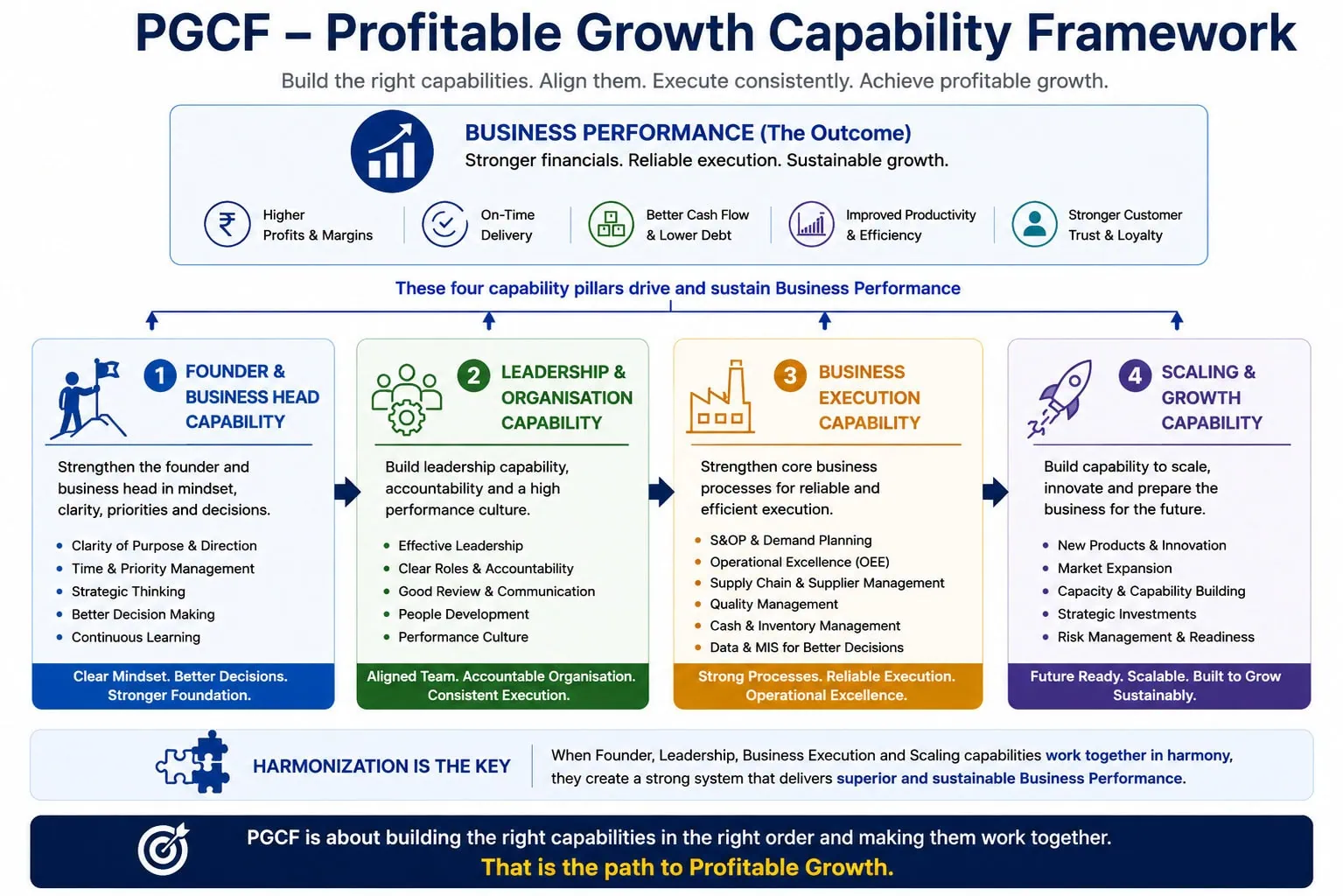
PGCF looks at the capabilities a growing business needs to strengthen across four interconnected areas:
The framework has evolved from my experience of working closely with SME founders and business leaders across India and understanding the capability gaps that often emerge as businesses grow.
When these capabilities become stronger and work together, they create better Business Performance and provide the foundation for sustainable profitable growth.
How PGCF creates profitable growth
The four capability pillars work together to strengthen Business Performance. The framework below shows how they connect.
Founder & Business Head Capability
Is the person leading the business evolving along with the business?
Why does this capability become important as the business grows?
In the early stages, a business can grow through the founder's personal involvement, quick decisions and direct problem-solving. But as customers, people, functions and complexity increase, the founder or business head has to evolve along with the business.
The role gradually needs to shift from managing everything personally to providing direction, making better business decisions, developing people and building an organisation that can perform beyond the founder.
What happens when this capability does not evolve?
The effects gradually become visible in the way decisions, priorities and people are managed.
What capabilities should a founder or business head develop?
As the business grows, the founder's capability needs to expand beyond functional expertise and personal involvement.
Explore related insights
Practical perspectives on developing the founder and business head capability required for a growing organisation.
Think Like a CEO: Developing Business Acumen
See the complete business beyond your own functional expertise.
Decisiveness in Leadership
Make clearer decisions and know when others should decide.
Your Business Growth Stagnates When You Do Not Step Up as a Leader
Understand how the founder's own evolution can become a growth constraint.
When Should a Founder Seek External Help?
Recognise when another perspective can help the business move forward.
Patience and Long-Term Focus
Build people, systems and growth with a longer-term leadership perspective.
Building Trust and Relationships in Leadership
Strengthen trust, connection and influence as a leader.
Leadership & Organisation Capability
Is the organisation becoming stronger as the business grows?
Why does leadership and organisation capability become important as the business grows?
As a business grows, the founder alone cannot provide all the direction, make every decision or coordinate every function. More people join, responsibilities expand and the organisation needs leaders who can take ownership and deliver results.
Growth therefore requires more than adding people. It requires clear roles, capable leaders, accountability, effective reviews and an organisation where different functions work together towards common business priorities.
What happens when the organisation does not develop along with the business?
The business may have more people and managers, but the founder can still remain the centre of coordination and decision-making.
What organisation capabilities need to become stronger?
A growing business needs an organisation that creates clarity, ownership, alignment and consistent execution.
Explore related insights
Practical perspectives on building leadership depth, accountability and a stronger organisation.
Building an Organisation Beyond the Founder
Move from founder dependency towards greater ownership across the organisation.
How Can SMEs Use KPIs to Improve Business Performance?
Build a performance management system through clear KPIs, ownership, targets and regular performance reviews.
Are Your Business Reviews Driving Action?
Move reviews beyond reporting numbers towards risks, decisions and actions.
Building Accountability in a Growing Organisation
Create clarity on ownership without pushing every decision back to the founder.
Developing Second Level Leaders in an SME
Build leadership depth, ownership and decision-making capability as the business grows beyond the founder.
Breaking Functional Silos in a Growing Business
Improve coordination when business outcomes depend on multiple functions working together.
Business Execution Capability
Can the business convert customer demand into reliable, efficient and profitable execution?
Why does execution capability become important as the business grows?
As a business grows, it has more customers, more orders, more products and more commitments to manage. Planning becomes more complex, delivery pressure increases and more working capital gets tied up in inventory and receivables.
At this stage, execution cannot continue through individual follow-up, experience and firefighting. Sales, operations, supply chain, quality, finance and other functions need to work together through stronger processes, systems and operating discipline.
What happens when execution capability does not keep pace with growth?
The organisation becomes busier, but the additional activity does not necessarily translate into better business performance.
What capabilities build a strong business execution engine?
Strong execution connects customer demand with disciplined functional execution and creates a more reliable, productive and scalable business.
What should stronger execution capability deliver?
Execution capability should ultimately improve business outcomes, not merely make individual functions more efficient.
Explore related insights
Practical perspectives on building stronger execution, delivery and operational capability.
Building Delivery Capabilities in SMEs
Understand why reliable delivery requires more than production follow-up.
Overall Equipment Effectiveness (OEE)
Understand the losses affecting productive capacity and business performance.
Lean System Thinking in Small Business
Improve the flow of the complete business rather than isolated processes.
Why S&OP Becomes Critical as a Business Grows
Align demand, capacity, materials and priorities before execution problems occur.
When Growth Starts Locking Cash in Inventory
Understand why inventory can increase even while the business remains short of cash.
Why Firefighting Becomes a Way of Working
Identify the capability gaps that keep an organisation in reactive mode.
Scaling & Growth Capability
Is the business ready to scale without losing profitability, control or organisational stability?
Why does scaling capability become important as the business grows?
As growth ambitions increase, the gap between the current business and the future business starts to widen. More products, customers, locations, people and investments have to be managed with greater clarity and discipline.
At this stage, scaling cannot depend only on opportunity, founder energy or short-term decisions. The business needs stronger plans, scalable systems, adequate capacity, leadership depth and governance so that growth creates more value without a proportionate increase in effort, cost or complexity.
What happens when the business tries to scale before it is ready?
Growth starts stretching the organisation faster than its people, systems and financial capability can keep up.
What capabilities help a business scale sustainably?
Sustainable scaling requires the business to prepare for growth before complexity, investment and organisational pressure increase.
What should strong scaling capability deliver?
Scaling is successful when the business becomes larger while remaining profitable, manageable and increasingly independent of individual people.
Explore related insights
Practical perspectives on preparing the business for expansion, investment and the next stage of profitable growth.
Is Your Business Ready for the Next Stage of Growth?
Assess whether people, systems, finances and leadership are ready before increasing scale and complexity.
How Should an SME Plan for Growth?
Translate growth ambition into priorities, financial targets and measurable execution milestones.
When Should a Growing Business Invest in Capacity?
Evaluate demand, utilisation, investment returns and readiness before adding capacity.
Should You Expand into a New Market, Product or Geography?
Evaluate expansion through strategic fit, capability, profitability and organisational readiness.
Can Your Current Business Model Handle Twice the Scale?
Understand whether roles, processes and systems can support growth without a proportionate increase in cost and complexity.
When Should a Founder Start Institutionalising the Business?
Build governance and continuity before the organisation becomes too dependent on individuals.
Business Performance
The outcome of stronger and better-aligned business capabilities.
Is growth actually making the business stronger?
Sales growth alone does not tell us whether the business is becoming healthier. A growing business should also improve profitability, customer delivery, cash flow, productivity and customer confidence.
PGCF therefore looks at Business Performance as the outcome of stronger Founder & Business Head, Leadership & Organisation, Business Execution and Scaling & Growth capabilities working together.
What should stronger capabilities ultimately improve?
These outcomes provide a practical indication of whether growth is making the business stronger or simply making it bigger.
Higher profits & margins
Growth should improve the quality of earnings, not only increase the level of sales.
On-time delivery
Customer commitments should become increasingly reliable as the organisation develops stronger execution capability.
Better cash flow & lower debt
Growth should generate cash rather than continuously increase dependence on working capital and borrowing.
Improved productivity & efficiency
The business should create more output and value from its people, assets and operating resources.
Stronger customer trust & loyalty
Reliable quality, delivery and responsiveness should strengthen customer confidence and long-term relationships.
The real question is not simply, “Are we growing?”
The better question is: “Is our growth improving profitability, cash flow, execution reliability, productivity and customer confidence?”
When these outcomes improve together, growth is becoming stronger and more sustainable.
Explore related insights
Practical perspectives on understanding whether business growth is actually improving performance.
Why Profitable Growth Matters More Than Sales Growth
Understand why becoming bigger without becoming stronger can eventually weaken the business.
Building Delivery Capabilities in SMEs
Understand why on-time delivery reflects much more than production performance alone.
Overall Equipment Effectiveness (OEE)
Understand whether installed capacity is being converted into productive and profitable output.
Why Can a Growing Business Still Struggle with Cash Flow?
Look beyond sales growth to understand working capital, inventory, debtors and cash conversion.
Why Does Profitability Fall Even When Sales Are Growing?
Examine margin leakage, cost growth and execution losses that can weaken profitable growth.
What Should an SME Founder Review Every Month?
Focus leadership attention on the few measures that show whether the business is becoming stronger.
Where is your business capability limiting profitable growth?
Every growing business has strengths and capability gaps. The challenge is to identify which gaps are now affecting profitability, execution, leadership effectiveness or the ability to scale.
The PGCF Business Assessment helps you look across the four capability pillars and Business Performance to understand where your business may need greater attention.
Assess your business readiness for profitable growthHow I use PGCF with founders
Every business has a different growth journey. The starting point, therefore, is not to improve everything at the same time.
I use PGCF to understand the business as a whole and identify the capability gaps that are currently limiting performance or creating difficulty in the next stage of growth.
The priority may be different for every business. For one company, the immediate need could be stronger execution and delivery. For another, it could be leadership capability, profitability, cash flow or readiness to scale.
The objective is to focus on the few capabilities that matter most at that stage and strengthen them in a practical way with the founder and the leadership team.
Understand the business
Look beyond individual symptoms and understand what is happening across the business.
Identify capability gaps
Find the few gaps that are constraining performance, profitability or growth.
Set the priorities
Decide what needs attention now instead of trying to improve everything together.
Strengthen execution
Work with the founder and team to build the required capability into the business.
Profitable growth does not come from strengthening one function in isolation. It comes from building the right capabilities, in the right areas, and making them work together.