

When everyone is working, why is delivery still a struggle?
I have seen this situation in many growing manufacturing SMEs.
Sales is bringing orders. Production is running the machines. Purchasing is following up with suppliers. People are working hard. Capacity utilisation may even look reasonably good.
Still, customer deliveries are missed.
Sales commits to a delivery date without sufficient visibility into capacity or manufacturability. Sometimes priorities change after the order enters production. Production feels that it is not getting adequate visibility of future demand from sales. Purchasing is trying to manage materials in response to changing requirements.
As the customer due date gets closer, the pressure starts building.
Sales starts following up with production. Production feels stressed because everything suddenly becomes urgent. Purchasing is asked to expedite materials. Priorities on the shop floor keep changing. One urgent order replaces another.
Slowly, planning gives way to firefighting.
The interesting part is that nobody may be deliberately doing anything wrong.
Each function may be doing its own job. But the organisation is not working together towards one common business commitment: what we have promised to the customer, what we need to bill, and how the entire organisation will deliver it.
And finally, who becomes the point of contact?
The founder.
A customer calls about a delayed delivery. Sales escalates another priority. Production asks which order to take first. Purchasing needs a decision. The founder starts personally connecting sales, production, purchasing, and customer commitments.
This is not only an operational problem.
Repeated delivery failures are starting to affect customer confidence. And for a growing SME, delivery reliability is a hygiene factor. A customer may appreciate an exceptional delivery once, but over time, the customer expects the organisation to deliver on its commitments.
When that reliability is missing, growth itself becomes difficult.
This is where Sales and Operations Planning (S&OP) becomes important.
S&OP is not merely about preparing another production plan or conducting another review meeting. It is about bringing sales, operations, supply chain, and other key functions together around a single integrated view of demand, capacity, resources, and customer commitments.
The real purpose is simple:
Can the organisation collectively plan what it wants to sell, understand what it can deliver, and reliably execute those commitments without relying on the founder to coordinate everything?
That is the business problem an effective S&OP process should solve.
What exactly is Sales and Operations Planning (S&OP)?
When I explain Sales and Operations Planning (S&OP) to SME founders, I usually start with a simple question.
Sales is doing its job. Operations is doing its job. But who is connecting the two?
Sales is at the front end of the business. It understands customers, enquiries, orders, changing requirements and future opportunities.
Operations is at the back end. It understands capacity, manpower, manufacturing constraints, materials, suppliers and what can realistically be produced and delivered.
Both are important. But neither can work effectively in isolation.
There has to be a process that connects the front end with the back end.
That is how I look at Sales and Operations Planning (S&OP).
S&OP is an integrated planning and coordination process that connects customer demand and sales commitments with the organisation’s capacity, materials, manpower and other resources required to deliver them.
The important word here is integrated.
It is not enough for sales to have a sales plan and production to have a production plan. The two plans have to talk to each other.
If sales expects higher demand three months from now, operations needs visibility today. If capacity will not be sufficient, the organisation needs to know it early enough to take action. If a critical material has a long lead time, purchasing will not learn of the requirement until production needs it. If a customer delivery date cannot realistically be met, sales needs that visibility before committing.
Someone also needs to look at this end-to-end rather than from the perspective of a single function.
In many SMEs, this may be a central planning function, a planning coordinator or another clearly defined coordinating mechanism. The designation is less important than the responsibility.
The purpose is to create one common view across the organisation:
What are we expecting to sell? What have we already committed? What can we realistically produce? What resources will we need? Where are the gaps? And what actions should we take now to deliver what we have promised?
When this connection happens systematically, S&OP stops being just a planning activity.
Sales and Operations Planning (S&OP) becomes the integrating process between the market and the organisation’s ability to deliver.
Why Emerging SMEs particularly need S&OP?
When an organisation is small, the founder himself can become the planning system.
He knows the customers personally. He knows what orders are expected. He talks directly to production and purchasing. If there is a problem, he can intervene and get things moving.
This may work reasonably well at a smaller scale.
But as the business grows, complexity increases.
More customers get added. Product mix increases. More people and equipment come in. New facilities may get added. Customer expectations increase. What the founder was earlier able to coordinate through relationships and personal involvement becomes increasingly difficult to manage.
At this stage, the business needs to move from founder-driven coordination to a structured, integrated planning process.
I saw this very clearly in one of the companies I worked with in the foam manufacturing business.
When the company had a turnover of around ₹12 crore, the promoter was able to manage much of the coordination personally. Later, the company invested in a new plant, relocated its operations and started expanding its customer base. It had capacity, orders and a capable team. But the increasing complexity became difficult to manage through the earlier way of working.
What was missing was not capacity or market opportunity.
It was integrated planning.
We introduced a structured S&OP process to connect demand, capacity, resources and execution. Within about a year, the company’s turnover increased by approximately 2.5 times.
Of course, the opportunity, capacity, customers and people were already there. S&OP did not create them. It helped the organisation bring them together and convert the available opportunity into execution.
That experience reinforced an important lesson for me:
As an SME grows, its planning system must grow as well.
The founder cannot remain the permanent point of contact between sales, operations, purchasing,e and customers. At some stage, the organisation needs a process that performs that integration systematically.
What information is required for effective S&OP?
Before starting S&OP, one basic question needs to be answered:
Do we have enough visibility to plan?
In many SMEs, planning becomes difficult because people are overwhelmed by the number of customers, products, part numbers, machines and orders. When everything is looked at individually, the complexity itself becomes a barrier to planning.
My first approach is therefore to reduce complexity into simplicity.
Start with product family grouping.
Instead of trying to plan hundreds of individual items at the beginning, group products into meaningful product families wherever possible.
A good family grouping helps us understand:
- Which products follow similar manufacturing processes?
- Which machines or resources do they consume?
- What capacity is available for each family?
- Where are the likely constraints?
This gives management a much clearer view of demand versus capacity.
Understand the demand pattern.
Historical sales alone are not enough. We need to understand how demand behaves.
What is the peak volume, lean volume and average volume for each major product family? Is there seasonality? How reliable has the customer’s forecast been?
This helps the organisation avoid planning everything based on one average number.
Know the real production capacity
Next comes capacity.
What can each critical process or group of machines realistically produce? Where are the bottlenecks? What happens to capacity when the product mix changes?
Having machines and having available capacity are not always the same thing.
Understand the supply-side constraints
The plan also needs visibility beyond the factory.
How many critical suppliers and subcontractors are involved? What is their capacity? What are their lead times? Which materials or outsourced processes can become constraints?
A production plan that doesn’t account for supply lead time can easily become unrealistic.
Get visibility of inventory and order commitments
Finally, we need reliable information on:
Raw material, WIP and finished goods inventory, along with open sales orders, work orders or job orders, process status and the committed due date for each important line item.
Only then can we clearly see what is already available, what is under production, what needs to be procured and what has to be completed against customer commitments.
S&OP therefore does not start with a meeting.
It starts with creating enough visibility for people to make the right planning decisions.
How does the S&OP process work?
An effective S&OP process should connect the entire flow, from what we expect to sell to what needs to happen across production, materials, suppliers, and other resources to meet the customer commitment.
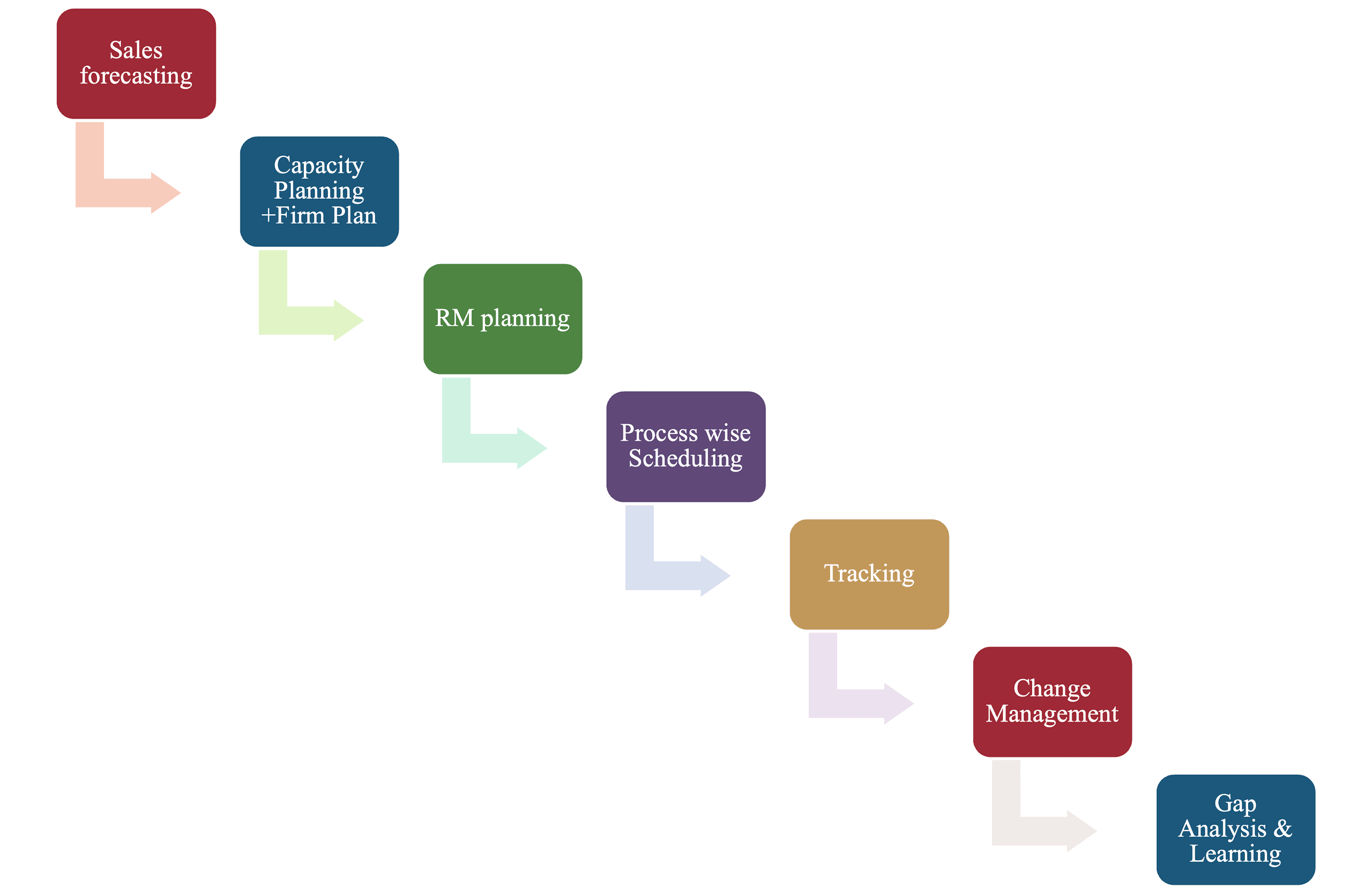
The process broadly moves through the following steps:
- Develop a rolling sales forecast
- Understand product mix, family grouping and process requirements
- Assess capacity and manpower requirements
- Identify gaps and make prioritisation, capacity reallocation or make-vs-buy decisions
- Plan materials, suppliers and inventory
- Backwards-plan from customer due dates
- Translate the plan into shop-wise and time-phased execution
- Review plan versus actual and close the gaps
- Coordinate continuously across functions and manage changes
The important point is that these are not independent planning activities.
The sales forecast influences capacity. Capacity influences production priorities. Production requirements influence material and supplier plans. All of them finally have to work backwards from the customer’s committed due date.
That is why S&OP must be seen as an end-to-end planning and coordination process, rather than simply a sales forecast or production-planning exercise.
Let us look at each step in practical terms.
Step 1: Develop a rolling sales forecast
The first step in S&OP is to create visibility of what is likely to happen over the next few months.
Why is this visibility important?
Because the organisation needs a reference point to plan.
How much raw material should we procure? Do we need an additional shift? Will the existing manpower be sufficient? Is there enough capacity? Should we plan subcontracting? Do we see a sales gap that needs to be filled?
We cannot wait for the orders to arrive before answering all these questions.
That is why I normally recommend a 1+3 rolling sales forecast. We review the current month’s firm position and maintain forward visibility for the next 3 months. The forecast keeps rolling forward as actual orders and new information come in.
The forecast can broadly be divided into two parts.
Confirmed or high-probability business: Orders already available, repetitive schedules, or opportunities where the sales team has reasonably high confidence, perhaps 80–90%.
Tentative or potential business: Opportunities that are still developing but have a reasonable possibility of conversion, perhaps 50–60%.
Putting these together gives us a working view of what the coming months could look like.
The purpose is not to claim that every number will happen exactly as forecast.
A forecast is a planning reference, not a promise.
It gives sales visibility of where the gaps are and which customers or opportunities need attention. At the same time, it gives operations, purchasing, and other functions an early indication of what may be coming.
“But our customers don’t give us forecasts”
This is one of the first responses I hear when I introduce forecasting in SMEs.
And it is a valid concern.
Not every customer has a mature planning system. Some customers may give reasonably good projections. Some may give only partial visibility. Others may not give a forecast at all.
But that does not mean we should operate without one.
First, ask the customer.
I have seen that when suppliers systematically start asking customers for forward visibility, some customers do provide it. It can also create a positive impression that the supplier is planning rather than reacting after receiving the order.
If the customer cannot provide a forecast, develop your own.
Look at past order patterns, the previous quarter or year, seasonality, current enquiries, customer relationships, known programmes and the judgement of the salesperson handling that account.
Then compare the forecast with what actually happens.
Where were we right? Where did we go wrong? Why did the customer buy more or less than expected?
Over time, the organisation begins to understand the pattern and improves its forecasting ability.
That is why I see sales forecasting as both science and art.
Data gives us a base. Customer conversations give us visibility. Experience and judgement help us interpret both. And continuous review improves forecast quality.
We do not need to wait for a perfect forecasting system before we start.
Make the first projection. Learn from the gap. Refine it. And keep rolling it forward.
That visibility becomes the starting point for capacity, manpower, material and execution planning in the remaining S&OP process.
Step 2: Convert the forecast into a realistic capacity plan
Once we have reasonable visibility of demand, the next question is:
Do we have the capacity to deliver what we are planning to sell?
This is where the sales forecast needs to be converted into an operational plan.
Start by grouping the forecast into product families. For each product family, understand the process sequence, cycle time and the critical resources it will consume.
Then make a rough-cut capacity plan.
The purpose is not to create a highly detailed production schedule at this stage. It is to establish whether our in-house capacity, manpower, and supply chain can broadly support the expected demand within the required time.
If capacity is adequate, we can move towards firming up the plan.
If it is not adequate, that is where an important cross-functional discussion has to happen.
The founder or business head, sales, production, planning and supply chain may need to sit together and decide:
- Which orders should we prioritise?
- Can some orders be moved to a later date with customer agreement?
- Which parts can be outsourced?
- Should we add an extra shift or overtime?
- Are there orders that we should consciously decline rather than commit and fail?
- How do we use the available capacity to deliver the right combination of customer commitment, billing and profitability?
These decisions should not be left until the end of the month when delivery pressure has already started.
For a monthly planning cycle, I prefer this discussion to happen towards the end of the previous month, say between the 25th and 31st, so that operations enters the new month with a reasonably firm plan.
Capacity utilisation alone can be misleading.
I learnt this very clearly in one casting and machining company I worked with.
The company had a critical machine with limited capacity. The general manager’s focus was to keep that machine loaded as much as possible. From a utilisation perspective, it appeared logical.
But the machine was frequently loaded with high-volume, low-value components.
The machine remained busy throughout the month, but some higher-value customer orders could not get enough capacity. At the end of the month, people had worked hard, machine utilisation looked good, and pending orders remained, yet billing was lower than expected.
The problem was not a lack of effort.
The capacity was being utilised, but it was not being prioritised from an overall business perspective.
We introduced a structured capacity-planning discussion involving the CEO, GM and sales team. Before loading the critical machine, they started deciding which products should be made in-house and which lower-value items could be outsourced.
This allowed the constrained internal capacity to be used more consciously while outsourced capacity supported the remaining delivery requirements.
Within about two months, the company’s margin improved from around 3% to 13%.
For the team, it was an eye-opener.
It reinforced an important lesson for me:
Good capacity planning is not about keeping every machine busy. It is about using constrained capacity for the right business priorities.
The outcome of rough-cut capacity planning should therefore be a firm, agreed-upon operating plan that sales, operations, and supply chain understand before execution begins.
Step 3: Align materials and supply chain with the firm plan
Once the firm operating plan is agreed, the next question is:
Will the required materials and outsourced supplies be available when production needs them?
This is where purchasing, stores, and the supply chain become integral parts of S&OP.
Based on the firm plan, the procurement team needs to assess material requirements, existing inventory, supplier lead times, and supplier capacity. Purchase orders must be released at the right time and followed through on so that material availability does not become a constraint on customer delivery.
But all materials cannot be planned in the same way.
Long-lead and short-lead items need different approaches
If a material has a long procurement lead time, waiting for the confirmed customer order may already be too late.
For such items, we need to understand the consumption pattern and procurement lead time and establish appropriate minimum and maximum inventory norms. The forecast then helps us anticipate future requirements, while the inventory protects against lead time.
If the required material is already available in stock, it can be allocated against the firm plan and replenishment can be initiated accordingly.
On the other hand, if an item can be reliably procured within the required production lead time, there may be no need to carry excess inventory. It can be ordered against the plan and followed up with the supplier.
The objective is therefore not simply to keep more stock.
It is to have the right material available at the right time without creating unnecessary inventory.
Outsourced operations also have to be part of the plan
The same principle applies to subcontracting.
If the capacity-planning stage has identified certain components or processes for outsourcing, the subcontracting team needs to know which material must be sent, when it must be sent, the subcontractor’s available capacity, and when the processed material must be returned.
Otherwise, outsourcing can shift the bottleneck from inside the factory to outside it.
This is where the coordinating role of the planning function becomes important.
The planner should not be doing the job of purchasing, production or sales. But the planning function has to ensure that sales demand, manufacturing requirements, materials, stores, and subcontracting all work to the same agreed plan.
That end-to-end coordination is what prevents the organisation from discovering material or supply problems only when the customer due date is approaching.
Step 4: Backward-plan from the customer due date
Once demand, capacity and materials are reasonably aligned, the next step is to convert the firm plan into an executable manufacturing schedule.
I strongly believe this planning should start from the customer due date and work backwards.
Suppose a customer order has to be dispatched on the 28th, and the manufacturing process involves casting, machining, assembly, inspection and packing.
Instead of asking, “When can we start this order?”, backward planning asks:
“If we have committed to dispatch on the 28th, when should every preceding activity be completed?”
A simple backward plan may look like this:
- Dispatch: 28th
- Packing: 27th
- Inspection: 26th
- Assembly: 24th–25th
- Machining: before assembly
- Casting: sufficiently early to allow machining and subsequent processes
The actual dates will naturally depend on the company’s process flow and processing lead times.
We also cannot plan only with ideal cycle times. Expected production losses, process reliability, OEE losses, and reasonable buffers for uncertainty need to be considered when setting the dates.
The same logic should be applied to each important sales order, work order or job order.
The plan should reach every shop
Backward planning has another important benefit.
Once the dates for each operation are established, the overall monthly commitment can be converted into shop-wise weekly and daily loading plans.
Now the machining supervisor knows what needs to be completed this week. Assembly knows what should arrive and when. Inspection knows what is coming next. Each shop can prepare the required manpower, machines, fixtures, tools, and gauges in advance.
This is where planning starts cascading through the organisation.
It is no longer only a sales plan, a billing plan, or a management plan.
It becomes an execution plan for the people who actually have to deliver it.
I saw the importance of this in one precision-component manufacturing company in Hosur.
Their overall processing lead time was around 63 days. That meant that if the company wanted to achieve a particular billing plan in June, it could not start thinking about it in June. The required activities had to begin almost two months earlier.
The team therefore worked backwards from the required delivery and billing dates and established process-wise schedules for the relevant items.
Once they started following this approach meticulously, the company gained much better visibility into what needed to start today to achieve the expected billing two months later. Their billing performance improved significantly.
The lesson is simple:
Today’s production plan may actually determine the billing two months from now.
The longer the manufacturing lead time, the more important backward planning becomes.
Step 5: Make the plan visible through MIS and reviews
A good plan alone will not ensure delivery.
Once execution starts, things will change. A machine may go down. Material may get delayed. Production may fall behind. A customer may change a requirement. An unexpected quality problem may arise.
The organisation therefore needs to know early:
What did we plan? What have we achieved? What is pending? And what could affect the upcoming customer commitments?
This is where a simple and disciplined S&OP MIS becomes important.
The central planning function should provide relevant stakeholders with daily, weekly, and monthly visibility into the plan and actual performance.
Depending on the nature of the business, the MIS can include:
- Plan vs actual and pending quantity/value
- Customer-wise and SKU-wise status
- Asking rate vs running rate
- Critical material or capacity shortages
- RM, WIP and FG inventory
- Day-wise and week-wise phasing of the monthly plan
- Risks to upcoming customer due dates
In some companies, I have used a simple 31-column daily tracking sheet, with customer-wise planned and actual performance tracked through the month.
The tool itself does not have to be sophisticated.
What matters is that everybody is looking at the same numbers.
Daily reviews should look ahead, not only look back
I have seen companies use a short daily S&OP review very effectively.
The cross-functional team reviews plan vs. actual, but, importantly, they also look ahead to the next few days.
What needs to be delivered? Is any material shortage likely? Is a critical operation falling behind? Is there any surprise that could affect the plan for the next 3 days? Who needs to act?
This makes the review proactive rather than becoming a meeting to explain yesterday’s failure.
It also brings sales, planning, production, purchasing, and other functions together around the same customer commitments.
Weekly reviews bring management alignment.
A higher-level weekly S&OP review can involve the founder or business head along with the respective functional heads.
Here, the discussion can move beyond individual orders to the overall weekly plan, billing outlook, significant deviations, capacity or supply constraints,s and decisions requiring management support.
Monthly reviews can then look at the broader picture: what was planned, what was achieved, where the recurring gaps occurred and what needs to change in the next planning cycle.
The exact frequency will differ from one organisation to another.
But the principle remains the same:
MIS creates visibility. Reviews create alignment. Actions close the gap.
When this rhythm becomes part of the organisation, S&OP is no longer something prepared once at the beginning of the month.
It becomes a living process that keeps the organisation connected to its customer commitments throughout the month.
Who should own and coordinate the S&OP process?
One question I often come across while establishing S&OP in an SME is:
Who should be responsible for this process?
My preference is to have a central planning person or function that looks at the business end-to-end and coordinates the S&OP process.
But there is an important distinction.
The planning person can coordinate S&OP. Customer delivery cannot be the planning person’s sole responsibility.
Sales is responsible for the commitments made to customers and for providing forward visibility.
Operations is responsible for executing the agreed plan.
Planning is responsible for connecting demand, capacity, materials, and execution, and for highlighting gaps early.
The supply chain is responsible for ensuring that materials and outsourced processes support the plan.
And ultimately, the founder or business head has to ensure that these functions work together towards the business commitment.
In my view, the sales head, operations head, and planning head should therefore have collective accountability for delivery, with the founder, CEO, or plant head providing the necessary leadership and making decisions.
Who makes a good S&OP planner?
In many SMEs, I have seen planning assigned to a relatively junior person.
There is nothing wrong with having young people in planning. But the question is whether the person has enough understanding and organisational influence to coordinate across functions.
An effective S&OP planner needs more than the ability to prepare schedules and Excel sheets.
The person should have:
- Good understanding of the company’s products and manufacturing processes
- Ability to see the business end-to-end rather than through one functional lens
- Analytical capability to understand demand, capacity and gaps
- Strong interpersonal and stakeholder-management skills
- Business acumen to understand the impact of planning decisions
- Flexibility to respond when assumptions change
- Ability to develop a Plan B when unexpected situations arise
- Confidence to influence functional heads and get things done
This is why, particularly in a growing SME, I prefer the planning role to have sufficient seniority and credibility within the organisation.
Depending on the size and structure of the company, the planning head may report to the plant head, CEO or directly to the founder.
But reporting structure alone will not make the role effective.
The person needs enough authority and empowerment to coordinate across functions, highlight risks, challenge an unrealistic plan and initiate alternative actions when required.
In some of the companies I have worked with, I have recommended establishing central planning as an independent function led by a capable senior person. Where the role has been properly empowered and supported by the leadership team, I have seen it work very effectively.
The objective, however, is not to create another department.
The purpose of the planning function is to ensure the entire organisation works to a single integrated plan and a single customer commitment.
Where does S&OP fit in the Profitable Growth Capability Framework?
In the Profitable Growth Capability Framework (PGCF), I view S&OP as an important part of the Business Execution Capability.
Profitable growth is not achieved simply because the business has more orders, machines or people. The organisation needs the capability to convert market opportunity into reliable execution.
S&OP helps build that capability by connecting:
Sales visibility → Capacity → Materials → Production → Customer delivery → Business performance
But S&OP also shows why business execution cannot be strengthened by processes alone.
Sales has to provide visibility. Operations has to commit to an executable plan. Planning has to connect the functions. Supply chain has to support the requirement. Functional heads have to resolve gaps together. And the founder has to move away from being the daily point of contact and build an organisation that can coordinate these decisions systematically.
So while S&OP is primarily an execution capability, it also strengthens leadership and organisational capability.
This is an important principle behind PGCF:
Profitable growth requires capabilities to work together, not individual functions to become stronger in isolation.
How do you know whether S&OP is working?
Finally, how do we know whether all these planning meetings, forecasts and reviews are actually making a difference?
I would not judge S&OP by the number of plans prepared or meetings conducted.
I would look at whether the business performance is improving.
A few measures can give us a good indication:
- On-Time Delivery (OTD): Are we consistently delivering what we committed to customers?
- Plan vs actual: Are we achieving the sales, billing and production plan we agreed at the beginning of the period?
- Forecast accuracy: Is our ability to anticipate future demand improving over time?
- Capacity utilisation: Are we making better use of available capacity, particularly critical and constrained resources?
- Inventory: Are RM, WIP and FG becoming more aligned with actual business requirements?
- Profitability and margin: Is better planning translating into better business performance rather than merely higher activity?
No single measure should be looked at in isolation.
For example, high capacity utilisation does not necessarily mean that S&OP is working well if customer deliveries are still being missed or margins are suffering. Similarly, maintaining high inventory may temporarily protect delivery, but it may hide weaknesses in planning.
The real indication is whether these measures start improving together.
From less than ₹50 lakh to around ₹1.3 crore monthly billing
I saw this very clearly in one aerospace manufacturing company I worked with.
The company had orders. It had capacity. It had people. The promoter was also conducting review meetings.
Still, monthly billing struggled to cross ₹50 lakh.
When we looked more deeply, the issue was not simply a lack of orders or resources. The different elements of planning were not adequately connected.
We strengthened the S&OP process through improved forecasting, capacity planning, prioritisation, backward planning based on customer due dates, and more structured reviews. The promoter and the functional team began viewing the business through an integrated planning process rather than reacting to individual priorities.
Within about three months, monthly billing increased from less than ₹50 lakh to around ₹1.3 crore.
For me, this was another powerful demonstration of what S&OP can do in an emerging organisation.
The capacity was there.
The people were there.
The orders were there.
What was missing was the process that connected them.
That is ultimately how I look at the effectiveness of S&OP.
It should help the organisation convert its available market opportunity, people and resources into reliable customer delivery and better business performance.