
You will learn
What is meant by KPI or key performance indicator?
“A Key Performance Indicator (KPI) is a measurable indicator used to track progress towards an important business objective.”
For example,
One indicator of body health is heart rate, which can be measured as 60 to 100 beats per minute for an average adult. It is considered a key performance indicator of body health. Similarly, other performance indicators, such as blood pressure and sugar level, can also be used to assess the body’s overall health.
Similarly, numerous interactions, activities, and transactions occur within an organization across various functions or the value chain. However, only a few of these activities actually lead to significant performance improvements. This performance can manifest in increased productivity, profitability, sales, or improved morale. Some performances are not negotiable but vital for organizational profitability and growth, and those performances are called key performance indicators (KPIs). That means those performance indicators measure organizational health.
Why are KPIs important for SMEs?
We all know that “What gets measured gets improved.”
Identifying and setting Key Performance Indicators (KPI) targets can help organizations in many ways, such as focusing on important deliverables, bringing people together towards one goal, improving accountability, enhancing communication among stakeholders, knowing the reality against the desired target at any point in time, and taking corrective measures based on the reality versus target.
Although KPIs will vary by industry and organization, most fall under the broad categories of productivity, quality, cost, and delivery.
What is the difference between a metric, performance indicator and KPI?
Think of it this way.
A manufacturing company may measure hundreds of numbers every month. But all numbers do not deserve the CEO’s attention.
Metric — Something we measure.
Example: Machine downtime = 40 hours
Performance Indicator — Tells us how well an activity or process is performing.
Example: Production plan achievement = 88%
KPI — Key Performance Indicator — A critical measure that tells us whether an important business priority is being achieved.
Example: On-Time Delivery = 72% against a target of 95%
Suppose customer deliveries are the company’s biggest concern. Then OTD becomes a KPI because improving it is critical to customer satisfaction and business performance.
Production achievement, material availability, supplier delivery, OEE and rejection may become supporting indicators that help the team understand why OTD is improving or falling.
The simple principle for a CEO is:
Measure many things. Monitor important indicators. Focus leadership attention on the few KPIs that really drive business performance.
If everything is called a KPI, nothing remains key.
How do KPIs improve business performance?
KPIs improve business performance by making the organisation focus on what really matters and where attention is required.
For example, assume a manufacturing company has an On-Time Delivery (OTD) of 70%, while its target is 95%.
Once OTD becomes a KPI and is reviewed regularly, the leadership team starts asking:
Why are we missing customer delivery commitments?
The reasons may become visible:
- Production plan achievement is only 80%.
- Supplier delivery performance is poor.
- Machine downtime is high.
- Rejection and rework are affecting capacity.
- Materials are not available when required.
Now the discussion moves from “deliveries are getting delayed” to identifying and addressing the actual causes of poor delivery performance.
The same principle applies to profitability. If operating margin is a KPI, management begins looking deeper into material cost, productivity, rejection, overtime, inventory, pricing and other factors affecting the margin.
This is the real power of KPIs.
KPIs make performance visible.
Visibility creates focus.
Focus leads to corrective action.
Consistent action improves business performance.
For a CEO, KPIs therefore provide a simple way to know where the business stands, where it is falling behind, and where leadership attention is required.
What are some practical KPI examples for SMEs?
I suggest some common key performance indicators (KPIs) for measuring the performance of manufacturing functions.
Please note that this list is for informational purposes only, and you’re free to adjust or add to these KPIs based on your company’s goals and priorities.
S. No | Key performance Indicator | Unit of Measure | Existing Level | Target Level |
1 | % | 20% | 60% | |
2 | Assy time per components | Min/comp | 2 min | 1.5 min |
3 | Total Tonnes produced | Tonnes/ day | 100 T / day | 150 T / day |
4 | Internal rejection over sales | % | 1% | 0.5 % |
5 | Electrical energy consumption | No of units/day | 1000 units | 900 units |
6 | Inventory -WIP over sales | WIP % | 2% | 1% |
7 | Manpower absenteeism | % | 10% | 6% |
8 | 5S score | % | 40 % | 75% |
9 | Process Yield loss | % | 2% | 1% |
10 | Critical spares adherence | % | 40% | 100% |
I suggest some common key performance indicators (KPIs) for measuring the performance of Finance functions.
Please note that this list is for informational purposes only, and you’re free to adjust or add to these KPIs based on your company’s goals and priorities.
S. No | Key performance Indicator | Unit of Measure | Existing Level | Target Level |
1 | COGS | % | 50 % | 45% |
2 | Net Profitability | % | 12% | 20% |
3 | Outstanding payables> 30 days | Rs | 10 million | 0 |
4 | Outstanding receivables> 30 days | Rs | 5 million | 0 |
5 | Working capital cycle | No of days | 38 days | 28 days |
6 | Statutory compliance | % | 80% | 100% |
7 | Cost saving through projects | Rs | 2 million | 5 million |
8 | Manpower cost | % | 20% | 15% |
9 | Finance cost | % | 2% | 1% |
10 | Inventory as % of sales | % | 10% | 6% |
I suggest some common key performance indicators (KPIs) for measuring the performance of Quality functions.
Please note that this list is for informational purposes only, and you’re free to adjust or add to these KPIs based on your company’s goals and priorities.
S. No | Key performance Indicator | Unit of Measure | Existing Level | Target Level |
1 | Quality Performance in OEE | % | 80% | 100% |
2 | First pass approval Time | Min/comp | 10 min | 8 min |
3 | Response time for customer complaints | Hours/complaint | 40 Hours | 24 Hours
|
4 | Internal rejection over sales | % | 1% | 0.5 % |
5 | No of SOP was created | No’s / month | 2 | 4 |
6 | No of process -audits/compliance | No’s | 10 / month | 25 / month |
7 | Manpower absenteeism | % | 10% | 6% |
8 | Calibration compliance | % | 40 % | 100%
|
9 | Process Yield loss | % | 2% | 1% |
10 | Cost of poor quality | Rs per product | Rs 350 | Rs 200 |
I suggest some common key performance indicators (KPIs) for measuring the performance of Sales functions.
Please note that this list is for informational purposes only, and you’re free to adjust or add to these KPIs based on your company’s goals and priorities.
S. No | Key performance Indicator | Unit of Measure | Existing Level | Target Level |
1 | No of new leads generated per month | No’s | 10 | 30 |
2 | No of customer visits per month | No’s / Month | 1 | 5 |
3 | Average response time for quote | Hours/quote | 48 Hours | 24 Hours
|
4 | Query Conversion ratio | % | 2 % | 15 % |
5 | Sales per month | Rs per month | 20 million | 50 million |
6 | No of NEW customer | No’s | One / month | Five / month |
7 | NPD sales | % | 2% | 15% |
8 | Outstanding receivables > 30 days | Rs | 10 million | 0
|
9 | Marketing expenses | % | 12% | 10% |
10 | Average Response time to complaints | Hours | 36 hrs | 24 hrs |
What is the CEO's role in making KPIs effective?
One of the critical responsibilities of a business head or CEO is to set business goals and provide direction. When setting targets, the head should thoroughly prepare and set achievable goals for the team within a given time, resource, and capability. The target should not be unrealistic or aspirational and should not be too lenient with incremental increases, as this may not motivate the team to work effectively.
In many small to medium-sized enterprises (SMEs), we commonly observe that the CEO or business head is not entirely convinced about the target they have set. Despite this, they often push their team to achieve unrealistic targets while expressing pessimism about the team’s ability to meet them, sometimes even setting low targets. This behavior is reflected in the CEO or business head’s communication tone and body language, which can create uncertainty among the team.
“If the CEO or business head sets a target with conviction, they are more likely to achieve it and will do everything in their power to meet it. Their strong belief in the goal will also help them identify and act on opportunities that arise. Furthermore, when the team works towards ambitious goals under visionary leadership, they are motivated to perform their best.”
In one of our client organizations, the CEO had set a production target of 10 tons per day. He was confident in his decision and had the support of his entire team. However, during the financial year, the demand from their existing customer became uncertain, which disrupted his business plan. Despite this setback, he remained committed to his production target of 10 tons per day. He adopted a different approach to secure a new customer and achieve his goal. This achievement boosted his confidence, and it also improved the morale of his team.
Performance management cultivates a culture of solution-oriented and high-performing individuals, providing organizations with a competitive edge.
How can setting targets (KPIs) and review forums boost your business performance?
Let’s discuss the importance of setting and reviewing business targets as a management process to control business performance. As an organization grows from small to large, complexity increases due to more customers, products, people, and other factors. Communication also becomes complicated among all stakeholders. Setting and reviewing targets becomes crucial to overcome this complexity and bring accountability.
The targets can be categorized into Business targets, Functional Targets, and Individual Targets, which are also known as Key Performance Indicators (KPIs). Depending on the size of the organization and the bandwidth to administer the performance management system, the business head can set the targets in the following hierarchy:
- Business Key Performance Indicators
- Functional Key Performance Indicators
- People Key Performance Indicators
It is recommended to start with Business Key Performance Indicators covering all functional deliverables in terms of the following categories:
- Productivity
- Quality
- Cost
- Delivery
- People Engagement
For instance, “Manufacturing cost per component” is one of the key performance indicators under the category of “Cost.” To achieve this KPI target, all functions have to contribute, and the business-level KPI target setting covers all functions.
Once the organization becomes familiar with target setting at the business level and acquires competency, it can move to the next level of target setting at the functional and individual levels.
Business-level KPIs can be set annually and tracked every month, week, and day.
The monthly review of key performance indicators (KPIs) examines the previous month’s business and functional performance against the set targets. The objective is to discuss and devise an action plan to enhance business performance in the following month. However, many small and medium enterprise (SME) business leaders do not consistently conduct the monthly review of business performance indicators.
A smart organization sets business and functional key performance indicators (KPIs) at the beginning of each year. The team reviews the progress or status of each KPI every month before the 10th of the month. This helps to monitor performance and ensure that the organization is on track.
Advantages of reviewing KPI’s status along with the team
1. The team is aware of the goal set and status at any point in time
2. The team becomes accountable for results as they are being questioned on their performance every month
3. Ownership and engagement improve as data is shared and communicated to all
4. Helps the organization to improve its performance in the subsequent month. In the absence of monthly KPI reviews, response time would become less (P-D-C-A cycle)
5. When the monthly reviews become a culture, all the functions are keen on data accuracy and timely data sharing. In the absence of monthly routine reviews, data capturing and analysis itself is a significant task for the business head
However, many small and medium enterprise (SME) business leaders do not consistently conduct the monthly review of business performance indicators.
Why some business leaders hesitate to review their KPIs consistently?
Certain beliefs hold them back. Let’s examine them closer to see if we can understand their perspective.
1. As I am spending full time here, I know the P&L trend, and it is not required to conduct reviews with the team
2. The team does not have the time, or no people are capable of collecting and organizing all the data
3. Why should we discuss all the information with the team?
4. Meetings are going to be time wasters as nobody is going to give solutions.
Reexamine your business practices and beliefs about monthly business and functional KPIs and initiate a performance-based culture in your organization!
How do you set KPIs or performance management for your business?
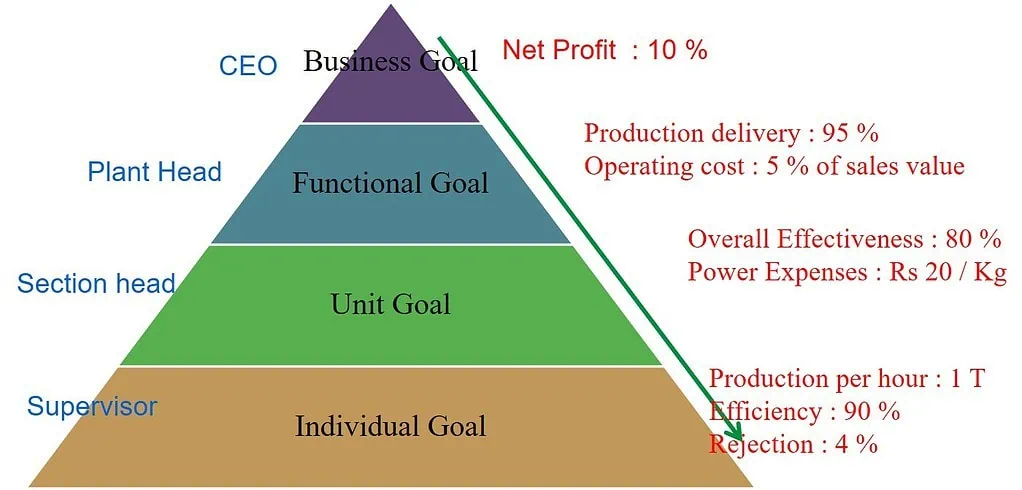
Setting KPIs and targets can be done at the business, functional, and individual levels. However, it is recommended that SMEs begin at the business level and then move on to the functional and individual levels once they become familiar with the performance management system.
To implement a performance management system at the organizational level, SMEs can follow these steps:
- Identify the criteria for measuring the key performance indicators (KPIs). SMEs can classify business objectives into criteria, such as productivity, quality, cost, delivery, and engagement.
- Identify the key performance measurements for each criterion essential to the business. For example, one of the key performance indicators under productivity could be OEE (Overall Equipment Effectiveness) or sales per employee.
- Set a realistic target for each KPI. This target can be based on historical performance or futuristic aspirations.
- Assign people responsibility for each KPI.
- Once targets are fixed for all key performance indicators in each category, track them every month against actual performance.
How can an SME implement a performance management system step by step?
One of the dreams or visions of most business heads of small, merging organizations is to make the organization system-driven and implement performance-driven management.
As we discussed the need for an organization-wide performance management system, let us learn the step-by-step implementation steps to ensure performance management throughout the organization.
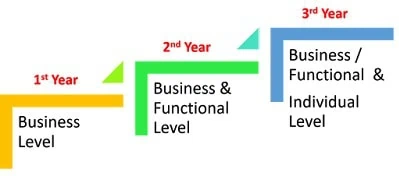
Step1:
Implementing business performance management and keeping the second-level reporters as stakeholders.
Business Level Performance Management:
When an organization is small or is getting into the performance management system for the first time, the logical step is to determine the important business key performance metrics along with some functional key performance metrics and start measuring. Key performance metrics can be measured and tracked by the business heads and their second-level reporters, mainly functional heads.
For example, some of the business KPIs like sales turnover, inventory cost as a % of sales, Plant effectiveness, attrition rate, and % of NPD contribution over sales can be measured and tracked. This set of performance metrics can be reviewed along with functional heads, and they can be encouraged to work on the action plan to improve business performance.
Depending on the organisation’s maturity and management bandwidth, this stage may take several months before the system becomes a regular management practice.
Benefits of business-level performance management:
1. The senior leadership team becomes familiar with performance management. Even though they do not feel fully accountable for the results, they feel they are part of the process.
2. Enhances the engagement among functional heads or second-level reporters when the business head reviews along with them every month.
Step 2:
Implementing Business performance management as done in the first year and arriving at suitable functional level performance management, keeping the second level reporters and their team as stakeholders.
Business +Functional Level Performance Management
Since the organization familiarized itself with a business-level performance management system in the first year, it can now have Business performance metrics that can be set by the business head and tracked along with the functional head.
Detailed functional-level performance metrics can be set and assigned to the second or operational head levels. The functional performance parameters can be more functional-oriented, and some business metrics are derived from business KPIs from the business head.
For example, the supply chain function can have more functional metrics, such as the number of vendors developed, inventory levels at different levels, freight cost as a percentage of sales, and so on. Similarly, we can have more functional-level metrics for all functions that can be assigned to respective functional heads and their teams.
The functional heads and teams can be encouraged to present the performance metrics trend and a detailed action plan for the business head every month.
The duration of implementation of this process can be one year.
Benefits of business + functional performance management:
1. The focus will be given in-depth to the functional effectiveness; by the way, measurements are extended to all functional key activities
2. Since we involve functional heads and their team, their involvement and focus are improved on functional effectiveness
3. Most organizations have different functional metrics and performance measurement systems. Eventually, there will be an improvement in the communication process, visibility of issues, and solutions approach, and understanding the pains of cross functions will enhance significantly.
4. Eventually, engagement enhances across functions
Step 3 :
Implementing Individual-level performance metrics, which are derived from business and functional performance metrics
Business Performance Management + Functional Performance Management + Individual Performance Management:
Since the organization familiarized itself with the business performance management system in the first year and the functional team engaged in the functional performance system in the second year, the organization now widens the performance management net to all its people. Ideally, it can be extended to executives and first-line supervisors.
In this process, each individual is given a set of performance metrics that will link with the functional parameters derived from business metrics.
Each individual is accountable for improving their metrics and reporting the progress. The review period can be once every quarter or monthly, depending on the organization’s bandwidth. It is the responsibility of the functional head to review the progress of their team members.
For example, depending on their level in the organization, the individual can be given performance metrics related to their functions. Also, some of the development plans can be added.
By the way, almost the entire organization is governed by performance metrics related to business and functions.
How do companywide KPIs contribute to profitable growth?
1. Setting the direction for the organization at the business, functional, and individual levels improves focus and engagement.
2. Eventually, the organization gets clarity of performer and non-performer, and this will help to focus on people’s developmental efforts
3. When the rewards and recognitions are based on the performance, it brings visibility, differentiates the performers and non-performers, improves the culture towards self and organizational performance improvement
Overall, performance management brings engagement among people, eases communication, improves focus on results or solutions, and thereby makes culture more about winning than blaming or complaining.
Profitable growth requires more than increasing sales. An organisation must also continuously improve productivity, quality, cost, delivery and cash flow.
The right KPIs make these business priorities visible.
For example, a manufacturing company may track:
- OTD: 75% → Target 95%
- Rejection: 4% → Target below 2%
- OEE: 45% → Target 60%
- Receivable days: 60 → Target 45
- Operating profit: 8% → Target 12%
When these KPIs are reviewed regularly, performance gaps become visible. The leadership team can identify problems early, assign responsibility and take corrective actions.
Over time, this builds greater focus, accountability and execution discipline across the organisation.
KPIs make performance visible. Visibility creates focus. Focus drives action. Consistent action improves business performance.
That is how an effective KPI system contributes to profitable and sustainable growth.
A reflection for SME founders and CEOs
In my work with SMEs, I have observed that most organisations are already measuring many things.
The real challenge is identifying which few measures truly matter to the business, setting clear targets and reviewing them consistently.
When the right KPIs are visible, conversations become more objective. Teams understand where performance is falling short, problems surface earlier, and accountability improves.
As a founder or CEO, ask yourself:
What are the 5–10 numbers that tell me whether my business is becoming stronger or weaker?
Can your leadership team answer the same question?
If those numbers are not clear, that may be the right place to begin.
A good KPI system should ultimately help the organisation focus on what matters, take timely action and continuously improve business performance.
Implementing the organization-wide performance management system is a long process. It needs to be implemented in a phased manner to sustain the results and involve all the stakeholders to create a performance-based culture!
CEO and leadership team play a vital role in inculcating the performance culture
Frequently Asking Questions about KPIs
A founder should focus on a small set of KPIs that indicate the overall health of the business. Depending on the business priorities, these could include sales, order book, operating profit, cash flow, receivable days, inventory, On-Time Delivery, quality and productivity.
The exact KPIs will differ from one business to another. The important question is: Which few numbers tell me whether my business is becoming stronger or weaker?
There is no universal number.In my experience working with SMEs, around 20–25 well-chosen business KPIs can cover most critical areas. However, the number should depend on the organisation's size and its bandwidth to collect, review and act on the data. I always prefer to start with fewer KPIs and keep the system simple.
I would suggest to keep it less and simple so that you are not diluting your focus on key performances.
Repeatedly missing a KPI should trigger problem solving rather than repeated explanations.
For example, if OTD remains at 75% against a target of 95%, the leadership team should examine the underlying causes: capacity, material availability, supplier performance, quality losses, planning or other constraints.
The purpose of a KPI review is not merely to ask “Why did you miss the target?”
A better question is:
“What is preventing us from achieving the target, and what capability do we need to strengthen?”
KPIs can certainly form an important part of employee performance appraisal. However, I would not recommend evaluating an individual only on KPI achievement.
Leaders should also consider the individual's responsibilities, behaviours, problem-solving capability, teamwork, improvement initiatives and circumstances influencing the result.
KPIs should create clarity and accountability, rather than becoming only a mechanism for rating people.
No.
An SME can begin with a simple Excel or Google Sheets dashboard if the KPIs, targets, ownership and review process are clearly defined. Current small-business guidance similarly treats KPI selection and management discipline as foundational; sophisticated technology is not a prerequisite.
As the organisation grows and data becomes more complex, dashboards, ERP or business-intelligence tools can make measurement easier.
The discipline of reviewing and acting on the numbers is more important than the sophistication of the software.