
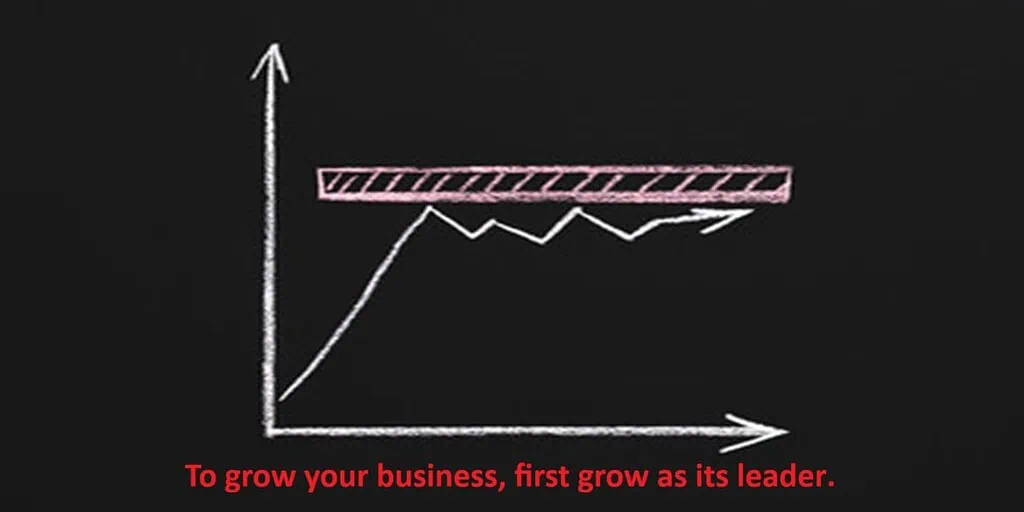
Why is my business not growing?Is founder dependency the problem?
Many SME founders build their businesses with tremendous entrepreneurial energy.
In the early stages, the founder knows almost everything happening in the business. He knows the customers personally. He understands the product. He follows production, quality and payments. He solves problems and gets things done through personal relationships and direct involvement.
And it works.
When there are fewer customers, fewer products, fewer machines and fewer people, one person can manage many things.
In fact, this involvement is often one of the reasons the business succeeds.
But as the business grows, something changes.
Customers increase. Products increase. People increase. Machines increase—transactions and communication increase. Problems also increase.
The business grows in complexity, but the founder’s bandwidth does not keep pace.
This is where I have seen some successful founders get stuck.
Why can the way you built your business eventually limit its growth?
I have seen founders continue to work in almost the same way even after their businesses have become much bigger.
They approve drawings.
They get involved in quotations.
They follow up on payments.
They meet customers for orders.
They handle banking matters.
They solve production and quality problems.
They speak individually with people to understand what is happening.
Each of these activities may be important.
But can one person continue doing all of them as the business grows?
At some point, something else starts to get missed.
Who is thinking about the next customer?
Who is thinking about the next product?
Who is building the next level of people?
Who is improving systems?
Who is looking at expansion, profitability and future opportunities?
This is the transition point many founders need to recognise.
What helped you build the business may not necessarily help you take it to the next level.
How do you know when founder dependency is becoming a growth constraint?
There are some patterns I have repeatedly observed.
Most important decisions still come to the promoter.
Second-level people hesitate to make decisions.
The founder spends considerable time calling individuals for updates, sometimes late into the evening, and giving instructions.
Firefighting becomes normal.
Sometimes decisions are driven more by opinions or by a few strong individuals than by data.
There may be no meaningful KPI tracking.
Structured review forums either do not happen or happen inconsistently.
Interestingly, many founders at this stage recognise the need for better reviews and systems.
But they are so occupied with today’s problems that they do not have the time to build them.
The founder works harder.
The team waits for the founder.
And the business continues to depend on the same person.
Over time, I have seen these symptoms show up in business performance too. Growth remains stagnant for two or three years. Profitability starts declining. The organisation remains busy, but the business does not seem to be moving to the next level.
The issue may not be a lack of effort.
The business may simply have outgrown the way it is being managed.
Why do founders hesitate to build a professional team?
I have been working with one company for the last six or seven years. Over the years, the business has grown to around ₹200 crore.
Initially, the founder-cum-managing director was personally involved in almost everything.
Planning, production, quality, customer handling and many other activities depended heavily on him.
I kept encouraging him to build a capable next-level team.
Initially, he was reluctant.
As I came to understand him better, I realised there was a genuine concern behind that reluctance.
If I bring senior professionals at a higher salary, will they really deliver?
How will I manage these professionals?
We have managed this as a family business so far.
I know my business better than an outsider. What will an outsider really add?
These concerns are understandable. I have seen similar thinking among many SME founders.
But gradually, he made the decision.
The company brought in external professionals for production, sales, maintenance, quality and other functions.
Was everything smooth after that?
No.
There were issues, as there will be whenever new people and new ways of working are introduced.
But today, many of those people have been with him for more than three years, and the team is working.
More importantly, the founder’s role has changed.
He now has more time to focus on another plant expansion, cost optimisatio,n and newproduct developmentt initiatives.
He has not lost control of the business.
He maintains a disciplined review rhythm with his team.
When I look back at this company, I feel happy about the transition.
The founder did not become less important.
He started spending more of his time on areas where his experience and judgement could create greater value for the business’s future.
Does reducing founder dependency mean giving up control?
I don’t believe so.
This is an important distinction.
Reducing founder dependency does not mean that every decision should be delegated.
Some decisions may still require the founder’s judgement.
The right level of delegation depends on the company’s size, the team’s capabilities, and the importance of the decision.
I have seen this even in pricing.
In one packaging company, more than 100 enquiries were being handled, and the founder was involved in pricing decisions.
We did not simply say, “Let the team handle pricing.”
Instead, we created a structured pricing template.
The team could work out the technical and standard elements. The founder’s knowledge was gradually transferred into a process. The final strategic pricing decision could remain with him.
In another company, the salespeople could prepare quotations and negotiate with customers, but they would get stuck when there was a price difference.
They would go back to the founder, and valuable time would be lost.
We created clear decision boundaries.
The salesperson could handle a small difference. At another level, the sales manager could make the decision. Only beyond a defined threshold did the CEO need to get involved.
That is how I look at delegation.
The question is not, “How do I stop taking decisions?”
The better question is:
“Which decisions genuinely need my judgement and which decisions can the organisation take without waiting for me?”
What needs to change as the business grows?
Building a team alone will not solve founder dependency.
I have seen companies with capable people where the founder still takes almost every important decision.
In one auto-component company with around ₹200 crore in revenue, experienced people had grown alongside the organisation.
The founder’s view was that his people were not knowledgeable enough or did not show sufficient interest in decision-making.
But the team’s view was different.
Their feeling was:
“Ultimately, the boss is going to decide. Why should we take ownership?”
This can become a cycle.
The founder does not delegate because he does not trust the team’s capability.
The team stops taking ownership because they know the founder will ultimately make the decision.
The founder then sees their lack of initiative as further evidence that they are not ready.
Breaking this cycle requires more than telling people to take responsibility.
The founder has to develop the practice of delegation.
Is the person capable of handling the task?
Have I clearly explained the expected outcome?
Have I given enough authority?
Can I support the person when he gets stuck without taking the task back?
Can I review progress at the right stages instead of checking every small activity?
And when the person succeeds, do I recognise it?
This is how capability and confidence gradually get built.
At the same time, the way the business is managed also has to mature.
As the organisation becomes more complex, structured reviews become increasingly important.
You cannot manage a larger organisation only through individual conversations, phone calls and personal follow-ups.
Good review forums bring people together. They create clarity on goals, highlight deviations, enable decisions and establish accountability.
KPIs provide visibility.
Decision boundaries create speed.
Capable people reduce unnecessary escalation.
Reviews provide control without requiring the founder to handle everything personally.
This is the shift from personal control to organisational capability.
Has your business outgrown the way you are leading it?
If you are a founder, I would suggest reflecting on a few questions.
What decisions are still coming to me that should no longer require me?
Where am I genuinely adding my judgement, and where am I merely adding another approval?
When I say my people do not take ownership, have I really given them the authority and space to take ownership?
What important work am I not doing because today’s operational issues consume my time?
And perhaps the most revealing question:
If I step away from my business for one month, what will continue to run smoothly, and what will immediately come to a halt?
The answers can tell you whether the business is growing through organisational capability or continuing to grow mainly through your personal bandwidth.
As the business grows, the founder’s role must also grow.
That does not mean moving away from the business.
It means shifting your time and attention to the work only you can do at the next stage: building the team, strengthening systems, reviewing performance, developing new opportunities, and preparing the organisation for its future.
Because ultimately, the person who created the growth should not become the constraint to the next stage of growth.
This transition is an important part of Founder & Business Head Capability in the Profitable Growth Capability Framework. As the business grows, the founder also needs to build the people, decision-making mechanisms, and management rhythm required for the organisation to grow beyond personal dependence.