

Why should founders look beyond sales growth?
Some time ago, I was speaking with the founder of a manufacturing business.
The company had been making losses for more than one year. Yet the factory was operating. People were being recruited. Salaries were being paid. Materials were being purchased, and customers were being supplied.
I asked him a simple question.
“How are you continuing to manage the business without making money?”
He replied:
“I am rotating the cash. I am using loans. Somehow, I am pushing it to the next year. I am hoping things will become better.”
I have heard different versions of this answer from more than one founder.
The company continues to operate, so everyone assumes the business is managing.
But continuing the activity is not the same as creating a healthy business.
A company may be busy yet financially weak.
It may report higher sales and still struggle to pay salaries and suppliers.
It may show accounting profit but have no cash available.
It may grow in size while becoming more dependent on loans, extended supplier credit and the founder’s personal intervention.
That is why I believe every founder should periodically ask:
Is my business merely becoming bigger, or is it becoming stronger as it grows?
Why can sales growth hide a weakening business?
When we ask founders about business performance, the answer usually begins with turnover.
“We have grown by 25 per cent.”
“We have crossed ₹50 crore.”
“We are planning to reach ₹100 crore.”
“We have added several new customers.”
I can understand the excitement.
Growth is visible.
The factory looks busy. More people are employed. New machines may be purchased. Bankers and customers notice the expansion. The organisation feels that it is moving forward.
Profit erosion does not attract the same attention.
Cash pressure is mostly visible only to the founder and finance team.
Operational leakages span several departments and may not be clearly captured in a single report.
By the time the problem becomes serious, the business may have already spent two or three years growing without becoming healthier.
What can we learn from a business that grew from ₹12 crore to ₹88 crore?
During one of my sessions with business leaders, I shared a company’s growth trend.
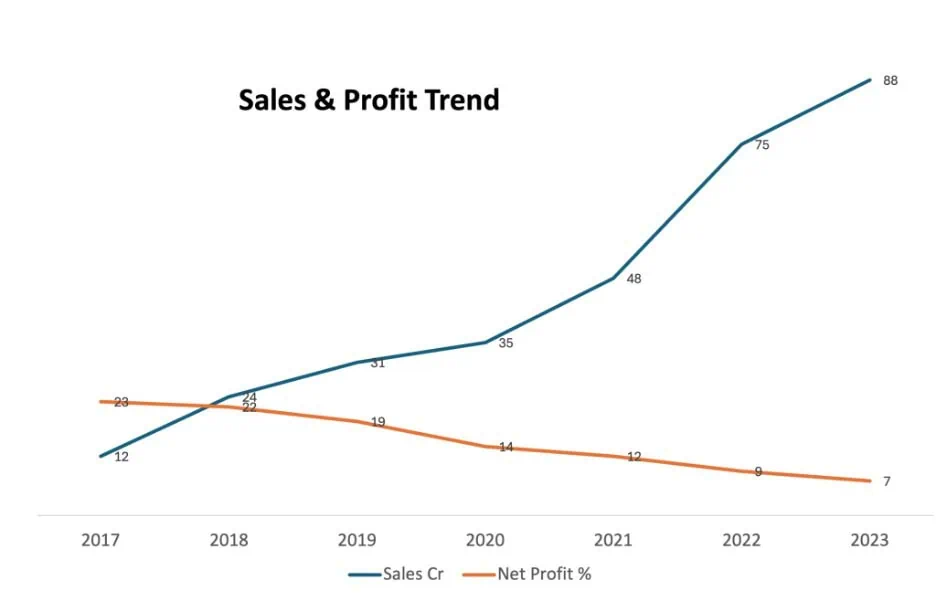
Its sales had increased from approximately ₹12 crore to ₹88 crore over six years.
The first response was appreciation.
The company had grown more than seven times. It appeared to be a very successful journey.
Then we looked at the net profit margin.
During the same period, the margin had fallen from approximately 23 per cent to 7 per cent.
That changed the conversation.
Earlier, every ₹1 crore of sales generated approximately ₹23 lakh of net profit.
Now, the same ₹1 crore of sales generated only around ₹7 lakh.
The company had certainly become much larger.
But had it become proportionately stronger?
Was it generating sufficient cash?
Was it becoming more resilient?
Had the organisation developed the leadership, systems and execution capability required to manage the higher level of business?
The graph was not saying that growth was wrong.
It was telling us that the quality of growth had changed.
What are your sales and profit numbers trying to tell you?
In my experience, when we look at sales and profit together over three to five years, businesses usually fall into four situations.
1. Sales and profits are growing
This is the position most founders would like to see.
The business is generating additional sales and retaining value from that growth.
Pricing, customer selection, product mix, cost control, and execution may support one another.
But even this position needs attention.
A profitable phase can create overconfidence. The company may begin accepting every order, adding too many products, increasing fixed expenses or expanding faster than its systems and people can handle.
The founder should therefore ask:
What is enabling our profitable growth, and are we strengthening it further?
Good performance should not only be celebrated. It should be understood and protected.
2. Sales are growing, but profits are not
This is one of the most common situations I see.
Orders are increasing. Machines are running. Employees are busy. The sales team is travelling. The founder is continuously involved in customer discussions.
There is plenty of movement.
But when we sit with the financial numbers, profit is not improving. Sometimes it is falling.
The leadership team should then ask:
Why is the additional sale not translating into additional profit?
The answer may be hidden in several places.
The company may be accepting low-margin orders. Costing may not reflect the actual cost of execution. Product or customer mix may have changed. Rejections and rework may be increasing. Delivery delays may be creating overtime and premium freight.
Inventory may be growing. Collections may be slowing. Interest costs and overheads may be increasing faster than sales.
Individually, each issue may appear manageable.
Together, they can quietly consume a major part of the margin.
The organisation may be working harder, handling more complexity and generating less value from every rupee of sales.
3. Sales are not growing significantly, but profits are improving
This situation is often misunderstood.
From the outside, the company may not appear to be growing.
But something important may be improving inside the business.
The organisation may have stopped accepting unprofitable orders. It may be moving away from customers who consume excessive time and working capital. Pricing discipline may be improving. Rejections may be reducing. Inventory may be coming under control.
The company may simply be making better decisions about which businesses to pursue and which to leave.
I have seen companies become healthier during periods when their turnover remained almost flat.
Sometimes, before pursuing the next stage of growth, the company needs to improve the quality of its existing business.
4. Sales and profits are both stagnant
Every business may experience a slow period.
But when sales and profit remain stagnant for several years, the founder should not look only at the sales team.
The issue may be deeper.
The market may have changed. The product may be losing relevance. The customer base may have become concentrated. The cost structure may be too heavy. The organisation may not have developed new capabilities.
The founder and leadership team may also be spending most of their time solving daily problems rather than building the next stage of the business.
At this point, I would not ask only:
“Which number is not moving?”
I would ask:
“What are these numbers trying to tell us about our business and our capability?”
Where is profit actually lost in an SME?
Is the margin quoted the same as the margin earned?
Profitability is sometimes treated as the responsibility of the finance department.
But finance mainly reports the outcome.
The profit may have been lost much earlier.
It may have been lost when an order was accepted without understanding its true cost.
It may have been lost when the customer was promised an unrealistic delivery date.
It may have been lost due to excess procurement, poor planning, low productivity, machine breakdowns, rejection, or rework.
It may have been lost when dispatch was delayed, the invoice was not raised on time or collection documentation was incomplete.
By the time the monthly accounts show the final margin, most of these operational and commercial decisions have already been made.
Profitability, therefore, cannot be managed solely through the P&L statement. It has to be protected through daily business decisions.
A company may accept an order believing that it will earn a margin of 15 per cent.
But what happens after the order is accepted?
The material does not arrive on time.
The machine breaks down.
The production plan changes repeatedly.
The product gets rejected and requires rework.
Employees work overtime.
The shipment goes through premium freight.
The invoice gets delayed.
The customer holds the payment because of documentation or quality issues.
After all these losses, the company may finally realise only 7 or 8 per cent.
The margin quoted during the commercial discussion is only an expectation.
The organisation earns that margin through execution.
That is why delivery capability and profitability are closely connected.
Why does stronger business capability improve profitability?
Whenever margins decline, many organisations immediately conclude that prices should be increased.
Sometimes a price correction is necessary.
But pricing power does not come only from negotiation.
It also comes from capability.
Customers value suppliers who provide consistent quality, on-time delivery, quick response, technical support, dependable communication, flexibility and reliable problem-solving.
Customers do not evaluate price alone.
They also evaluate risk.
A low-priced supplier who creates production interruptions, quality problems and repeated follow-up may eventually become more expensive for the customer.
A reliable supplier reduces the customer’s risk.
And that reliability has value.
Operational excellence, therefore, is not only a cost-reduction effort.
It can create customer trust, pricing strength and better profitability.
How does PGCF help build profitable growth capability?
This thinking is also at the heart of my Profitable Growth Capability Framework (PGCF).
I look at business performance as an outcome.
Profit, cash flow, margins, delivery, inventory and other business results do not improve sustainably merely because we set higher targets.
They improve when the capabilities behind those results become stronger.
PGCF therefore looks beyond the financial numbers and asks whether the founder, leadership, organisation, business execution and scaling capabilities are becoming strong enough to support the next stage of growth.
For me, this is the difference between simply chasing growth and building the capability for profitable growth.
What should your leadership team discuss now?
Take your business numbers from the last 3 to 5 years.
Do not look at turnover alone.
Put sales, profit and cash together.
Then discuss these questions with your leadership team:
- Are sales and profits growing together?
- Is every additional rupee of sales creating adequate profit and cash?
- Which customers and products genuinely create value for the business?
- Where are we losing margin between receiving the order and collecting the payment?
- Are OEE,rejection, rework, delivery delays, overtime and premium freight becoming accepted ways of working?
- Is inventory or receivables growing faster than sales?
- Are we funding growth through internal cash generation, or by increasing dependence on loans and delaying payments?
- Does the leadership team review profit and cash with the same seriousness as sales?
- Is organisational capability growing at the same pace as business complexity?
- Is the founder building the future or spending most of the time managing daily problems?
These questions may not give immediate answers.
But they can change the quality of the conversation.
And the quality of the conversation often determines the quality of the decisions that follow.
Every founder has the right to aspire for growth.
The concern is not growth itself.
The concern is growth without adequate profit, cash and capability.
The objective is not to choose between sales growth and profitability.
The objective is to build the capability to achieve profitable growth.