

How can manufacturing SMEs use AI and data analytics for better business decisions?
AI for Manufacturing SMEs:AI is becoming a common discussion in almost every business today.
Business owners are hearing about ChatGPT, AI agents, machine learning, predictive analytics and automation. Naturally, many are asking, “Where can we use AI in our business?”
It is a relevant question. But I would suggest starting with another question.
Over the years, while working with manufacturing businesses, I have seen enormous amounts of data being generated every day. Customer-wise sales, product-wise sales, quotations, lost orders, production, OEE, downtime, quality, inventory, purchase, receivables and financial performance.
The data is available. Yet, when we ask a few important business questions, getting clear answers is not always easy.
- Which customers and products are really contributing value to our business?
- Why is inventory increasing when sales have not increased proportionately?
- Which orders are we losing, and why?
- Where are we losing productive capacity?
- Which quality problems keep coming back?
- Why is delivery performance inconsistent?
For many manufacturing SMEs, answering these questions is a practical starting point for using AI. We do not necessarily have to begin with sophisticated automation. We can begin by learning more from the data we already have.
Are we collecting data or learning from it?
Having data and learning from data are two different things.
Even relatively small manufacturing companies have ERP systems, Excel reports, production records, quality reports and financial statements. Every department prepares numbers for the monthly review.
But reporting numbers is not the same as analysing them.
Suppose the review says that OEE is 62%. That tells us where we stand. It does not tell us why.
Which machines are affecting OEE? Is the bigger loss coming from breakdowns, setup time, speed losses or rejection? Does the loss increase with a particular product mix? Are the same problems recurring?
Once we start asking these questions, data becomes useful for problem solving and decision-making. A structured monthly business review should therefore go beyond presenting numbers and focus on understanding gaps and deciding actions.
Are data analytics and AI the same?
Not exactly. They are closely related, but they are not the same.
Data analytics helps us examine business information, identify trends, compare performance and understand patterns. Many valuable analyses can be done using Excel, ERP reports or business intelligence tools without AI.
AI-assisted analytics can help us explore data through questions, summarise large amounts of information, classify unstructured records and identify patterns worth investigating.
With suitable data and methods, predictive models can also estimate future demand, shortages or risks.
There is no need to make every analysis an AI project. The right question is whether the method helps us make a better business decision.
This is a progression, not a compulsory sequence for every application. A company may start with simple analysis today and gradually develop predictive capability as its data and management practices improve.
Where can analytics and AI create value in manufacturing?
When I discuss data analytics with manufacturing companies, I look at the business as a whole. The opportunity is not limited to production or the IT department.
The following visual is one I use to explain the potential scope. It brings together four areas: customer and product management, shopfloor effectiveness, supply chain effectiveness and people effectiveness.
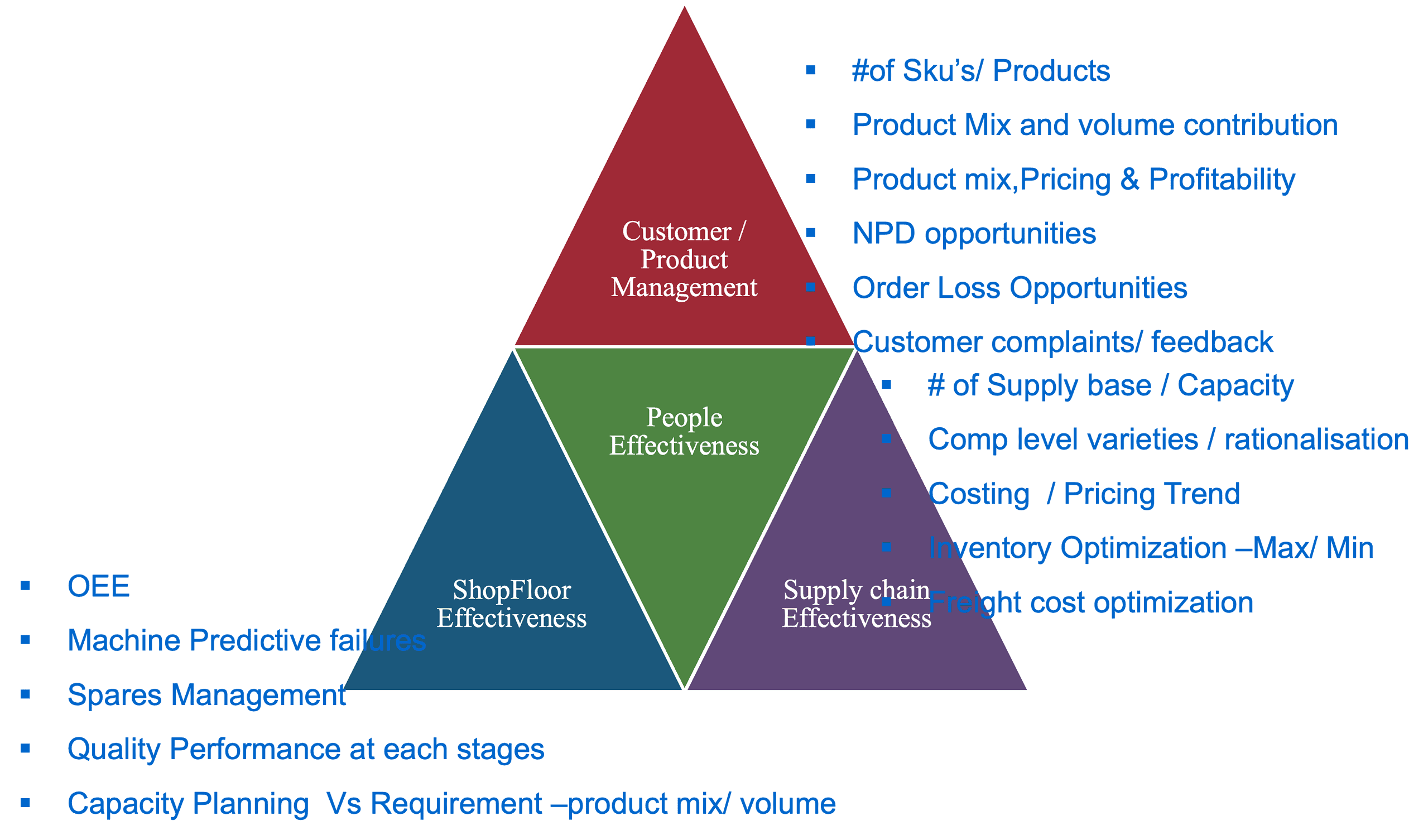
Let us look at what this means in everyday management decisions.
What can customer and product data tell us?
Most founders know their monthly sales. But total sales alone cannot tell us whether we are using our resources for the right business.
Which customers consume the most capacity? Which products bring higher sales but lower value? How do selling prices compare with material and conversion costs? Which quotations are being lost? What opportunities exist for new product development?
These are questions worth analysing before making decisions about additional machines, new customers or more salespeople.
A real client experience: When a reputed customer consumed 20% of capacity
In one manufacturing company I worked with, the business was serving around 65 customers, with nearly 10 product varieties for each customer.
We analysed the customer and product portfolio from two perspectives: volume and value contribution.
The analysis brought out something important. One of the company’s reputed customers was consuming nearly 20% of its manufacturing capacity, but the value contribution from that business was relatively low.
The customer was well known. The volumes were significant. But the amount of capacity being committed was not justified by the value it was generating.
The management first approached the customer for a price increase. The discussion did not result in an acceptable revision.
Instead of continuing the business only because it was a reputed customer, the company decided to reduce its exposure gradually.
Eventually, it exited the relationship and redirected the released capacity towards other higher-value customers.
The company’s turnover value subsequently increased by 8%.
Think about what actually happened here.
No additional manufacturing capacity was needed for this change. The company looked at its existing customer and product mix, understood where capacity was being consumed and made a conscious business decision.
This result came from data analytics and management judgement, not from AI.
But it shows the kind of opportunity that AI-assisted analytics could help companies identify, particularly when they handle hundreds of customer-product combinations.
Imagine periodically reviewing customer-wise capacity consumption, selling value, product mix, contribution and order trends together. Instead of discovering an unfavourable mix after several years, management could identify it much earlier.
Of course, a decision to exit a customer should also consider strategic importance, future opportunities, contractual commitments and the availability of replacement business.
Analytics should improve judgement, not replace it. This is important when the objective is profitable growth rather than sales growth alone.
How can shopfloor data improve productivity and delivery?
Production, downtime, setup time, rejections, rework and OEE are measured in many factories. But do we know the few recurring losses that are actually restricting output?
Suppose a plant is running below its expected capacity. The immediate reaction may be to add another machine or work an additional shift.
Before doing that, why not analyse where the existing capacity is going?
- Which machines are repeatedly breaking down?
- Which product families require frequent or lengthy setups?
- Where are speed losses occurring?
- At which process stages are rejections increasing?
- How will the expected product mix affect available capacity?
Good analysis helps us prioritise improvement instead of treating every loss as equally important. A proper OEE analysis can help identify the major availability, performance and quality losses that need management attention.
Where can AI add further value?
With reliable machine history, operating data and, where necessary, sensor information, predictive methods may help identify signs of potential failure or quality deterioration.
Capacity models can also help estimate future constraints when product mix and volume change.
However, predictive maintenance is not simply a matter of uploading a breakdown register and asking AI when the machine will fail. The quality and depth of data must support the prediction.
The objective remains practical: improve equipment availability, prevent losses and strengthen delivery capability.
Can analytics help reduce inventory without affecting delivery?
Inventory is another area where businesses often have considerable data but insufficient insight.
Suppose a company carries ₹3 crore of inventory. The monthly review concludes, “We have to reduce inventory.”
But where should the team start?
How much is raw material, WIP and finished goods? Which items are slow moving? Which items remain above the required stock level? Where do shortages occur despite high overall inventory?
How much excess is caused by minimum order quantities, long supplier lead times or changes in the sales plan?
These questions require systematic analysis of stock, consumption, orders, lead times and purchasing practices.
What comes after the initial analysis?
Once the company has reliable historical consumption, order visibility and supplier information, forecasting models can help estimate likely requirements.
They may flag materials at risk of shortage, items likely to become excess and purchase decisions that need attention.
Management can then decide whether to change replenishment levels, negotiate lead times, rationalise components or revise the purchase plan.
The outcome we want is not simply lower inventory. It is better material availability with less unnecessary working capital.
This requires a combination of inventory management discipline and an effective sales and operations planning process.
What can quality and customer complaints reveal?
Many organisations handle customer complaints one by one. The team prepares an 8D report, identifies a corrective action and closes the complaint.
But are we looking at all the complaints together?
Are the same defects appearing under different descriptions? Are complaints concentrated in a particular product, process or supplier? Which corrective actions have not prevented recurrence?
Much of this information sits in emails, complaint descriptions, inspection notes and problem-solving reports.
AI can help classify such records, group similar complaints and summarise recurring themes.
That can save time. But it is only the beginning.
The real task is to verify the causes at the workplace, implement corrective actions and check whether the problem has actually reduced.
An AI-generated explanation is not proof of root cause.
Can data analytics strengthen supply chain and supplier decisions?
Supply chain analysis goes beyond inventory.
How many suppliers do we depend on for critical components? Are we carrying too many component varieties? Which suppliers have unstable delivery performance? How are purchase prices and freight costs changing? Where is supplier capacity likely to become a constraint?
Even a simple analysis of supplier-wise quality, delivery, lead time, pricing and capacity can bring out opportunities for improvement.
As the data becomes stronger, predictive models may help flag supply risks.
But decisions about alternate sourcing, vendor development and commercial negotiation still require people who understand the business.
Can analytics help us develop people capability?
We often associate analytics with sales, machines, materials and money. But people capability is equally important.
Which operations depend on one or two experienced employees? Where are the skill gaps? What training has been conducted? Has training improved workplace performance? Which skills will become critical as the product mix or business volume changes?
A well-maintained skill matrix, training history and performance information can help managers make better development plans.
AI may assist in organising learning material, suggesting training topics and making internal knowledge easier to access.
However, people assessments and development decisions should be validated by managers, not delegated blindly to an AI system.
Can financial analytics show where profit is leaking?
A company may be growing in sales while its profits and cash flow remain under pressure.
In such a situation, I would like to see the relationship between sales, product mix, material costs, conversion costs, inventory, receivables and margins.
Are price increases keeping pace with cost increases? Which product families are contributing less than expected? Are overtime, rejection, rework or freight costs affecting margins? Is the business generating cash from its growth?
AI-assisted analysis may help management explore trends and exceptions faster.
Forecasting and scenario analysis can then support questions such as, “What happens to our cash position if collections are delayed?” or “What is the likely margin if material prices rise?”
But forecasts are estimates based on assumptions. They need to be reviewed against actual results.
The purpose is to make financial reviews more useful for decisions, rather than simply reviewing the previous month’s numbers.
How do we move from understanding the past to predicting the future?
Most management reports tell us what happened last month.
Last month’s sales. Last month’s OEE. Last month’s rejection. Last month’s inventory. Last month’s receivables.
These reports are necessary. But management also needs to look ahead.
- Which orders are at risk of missing delivery next month?
- Where could we face a material shortage?
- Which inventory items may become excess?
- What is the likely billing based on the current sales pipeline?
- Where will capacity become a constraint if product mix changes?
- What might happen to cash flow if customer payments are delayed?
These are predictive questions. Depending on the problem, the answer may come from a straightforward forecasting model, statistical analysis, simulation or more advanced machine learning.
AI is not automatically better than a simple forecasting method. We should choose the approach that gives reliable, understandable and useful results.
What about recommendations and action?
Prediction tells us what may happen. The next question is what we should do about it.
If a material shortage is likely, can we advance the purchase, develop an alternate supplier or revise the production sequence?
If sales are likely to fall short, which opportunities need attention?
If a product family is consuming too much constrained capacity, should we revisit pricing or product mix?
Here AI can support scenario comparisons and suggest possible options.
But the management team must evaluate the commercial, operational and customer implications before acting.
Can AI compensate for weak management practices?
No. And this is something we should be careful about.
If inventory records are unreliable, analysis will be unreliable. If salespeople do not update their pipeline, forecasting will suffer. If downtime is entered only as “machine problem”, the information is too vague for meaningful loss analysis.
And if no one takes action after receiving an insight, nothing improves.
In my problem-solving programmes, I have used a simple maturity journey: no data, data without analysis, good analysis, insights and root cause, action plan, implementation, and measurement of effectiveness through KPIs.
AI can make parts of this journey easier and faster. It cannot replace the discipline of defining a problem, verifying facts, deciding actions, assigning responsibility and reviewing results.
We also need to protect customer, employee and commercial information. Sensitive business records should only be used with AI tools under suitable confidentiality, access and data-handling arrangements.
Important outputs must be checked before business decisions are made.
Where should a manufacturing SME begin?
I would not recommend beginning with a large AI transformation programme.
Pick one important business problem. It could be excess inventory, recurring downtime, poor delivery, declining margins, lost orders or repeated customer complaints.
A practical starting approach
- Define the business question. What decision are we trying to improve?
- Identify the available data. What do we already capture in ERP, Excel or operating records?
- Check reliability. Are definitions consistent? Is the information complete enough?
- Analyse the patterns. Begin with simple tools. Use AI assistance where it adds value.
- Validate the insight. Discuss findings with people who understand the process and customers.
- Take action. Assign responsibility, agree on timelines and implement the decision.
- Measure the outcome. Did profitability, delivery, inventory, productivity or cash flow improve?
Once this works in one area, extend the practice to other functions.
Predictive applications can follow where there is a clear use case and sufficient reliable data.
What should AI ultimately deliver for the business?
There will be new AI tools and platforms every month. Small and emerging business owners do not need to chase every development.
I would keep returning to a few basic questions.
Where are we losing money? Where are we losing time? Where is our working capital blocked? Where are we losing orders or capacity? Which important decisions are we making without enough insight?
Then ask whether better use of data, analytics and AI can help.
Remember the client example discussed earlier. The company improved its turnover value by 8% after understanding its customer and product mix and reallocating capacity.
The improvement came not from a sophisticated technology investment, but from a better business decision.
That is the principle I would retain even as AI becomes more capable.
Technology and analytics should support stronger founder decisions, better organisational capability, reliable execution and sustainable growth. These are also important elements of the Profitable Growth Capability Framework.
For many manufacturing SMEs, the opportunity may already be sitting in their ERP, spreadsheets, production records, customer information and financial data.
Start by learning from what you already have. Then build the capability to anticipate what comes next.
Is your business getting enough value from its data?
Better decisions begin with understanding where the business is losing performance and which capabilities need attention.
Explore the Profitable Growth Capability Framework to see how these capabilities connect with profitable growth.