
A core capability within the Profitable Growth Capability Framework
Founder & Business Head Capability
As the business grows, the person leading the business must also evolve.
What helped you build the business may not be enough to lead its next stage of growth. As complexity increases, the founder or business head needs to think differently, make better decisions and build greater capability across the organisation.
The shift begins with the leader: stronger business acumen, clearer priorities, better delegation, empowered people and more time to shape the future.
When the leader evolves, the organisation becomes stronger and less dependent on one person.
Leadership evolution
Why must the leader evolve as the business grows?
The founder’s direct involvement may help build the business. As the organisation grows, leadership must gradually move from personal control to organisational capability.
During the early stage, the founder or business head can remain close to customers, employees, operations and finances. Decisions are quick, communication is direct and problems are addressed personally.
As the business expands, more customers, products, employees, suppliers and functions get added. The number of decisions and interdependencies also increases.
At this stage, continuous involvement in every issue can gradually slow down decisions, weaken ownership and make the organisation more dependent on one person.
The business may have grown in size, but the way it is being led may not have evolved at the same pace.
Complexity increases
More customers, people, products, suppliers and locations create greater coordination and decision-making needs.
Personal follow-up becomes insufficient
The founder can no longer track every activity personally. Reliable leaders, systems and reviews become essential.
The leadership role must change
The leader must spend less time repeatedly solving the same problems and more time strengthening the organisation.
What are the signs that the business is too dependent on one person?
These signals often appear gradually as the organisation grows.
Important decisions wait until the founder or business head is available.
Managers report problems upward instead of resolving them.
Customers expect the founder to become personally involved.
Delivery or quality performance drops when the leader is absent.
The same operational problems repeatedly reach the top.
Leadership time is consumed by approvals and daily follow-up.
How should the leadership contribution change?
The leader remains closely connected to the business, but begins contributing at a higher level.
Solving every problem
Repeatedly stepping in whenever an issue appears.
Asking better questions
Understanding why the problem is recurring and what is missing.
Building people and systems
Developing the capability to decide, execute and improve.
Shaping the future
Focusing on strategy, capability, profitability and long-term growth.
Leadership evolution begins when the founder or business head moves beyond continuous personal intervention and starts building an organisation that can think, decide and perform with greater confidence.
Understanding the capability
What is Founder & Business Head Capability?
It is the ability of the person leading the business to think, decide and lead at the level required by the present stage of the organisation and its next stage of growth.
Founder & Business Head Capability is the combined ability to provide direction, understand the whole business, make sound decisions, develop people and build an organisation that can perform with greater confidence and less dependency.
Who does this capability apply to?
The title may differ, but the person carrying overall responsibility for the business faces a similar leadership challenge.
Founders and Promoters
Leaders who have built the business through personal commitment, relationships, knowledge and direct involvement.
Second-Generation Leaders
Successors who must preserve the strengths of the business while developing their own judgement, credibility and direction.
Managing Directors and CEOs
Professional or owner-managers who carry responsibility for the overall performance, health and future of the organisation.
What does this capability require from the leader?
Strong leadership at the top combines four broad responsibilities.
Think
See beyond daily activities, understand the whole business, connect different functions and anticipate future needs.
Decide
Use business understanding, reliable data and sound judgement to make timely decisions with clear priorities.
Lead People
Create clarity, delegate authority, build confidence, encourage ownership and provide an environment where people can achieve.
Build the Organisation
Strengthen leaders, systems, culture and capabilities so that performance does not depend continuously on one person.
Why must the business head understand the complete business?
The organisation operates as one connected system. A decision in one area can affect several others.
In my book, Proven Path to Profitable Growth, I have explained six business drivers that every founder or business head must understand: customers and products, employees, profitability, cash flow, operational effectiveness and growth.
A leader may be highly experienced in one function. But responsibility for the complete business requires the ability to understand how these drivers influence one another.
This broader business view is what helps a functional expert evolve into a complete business leader.
Founder & Business Head Capability is ultimately about helping the person at the top create clarity, strengthen decisions, develop people and build an organisation capable of achieving profitable growth together.
The Founder & Business Head Capability Framework
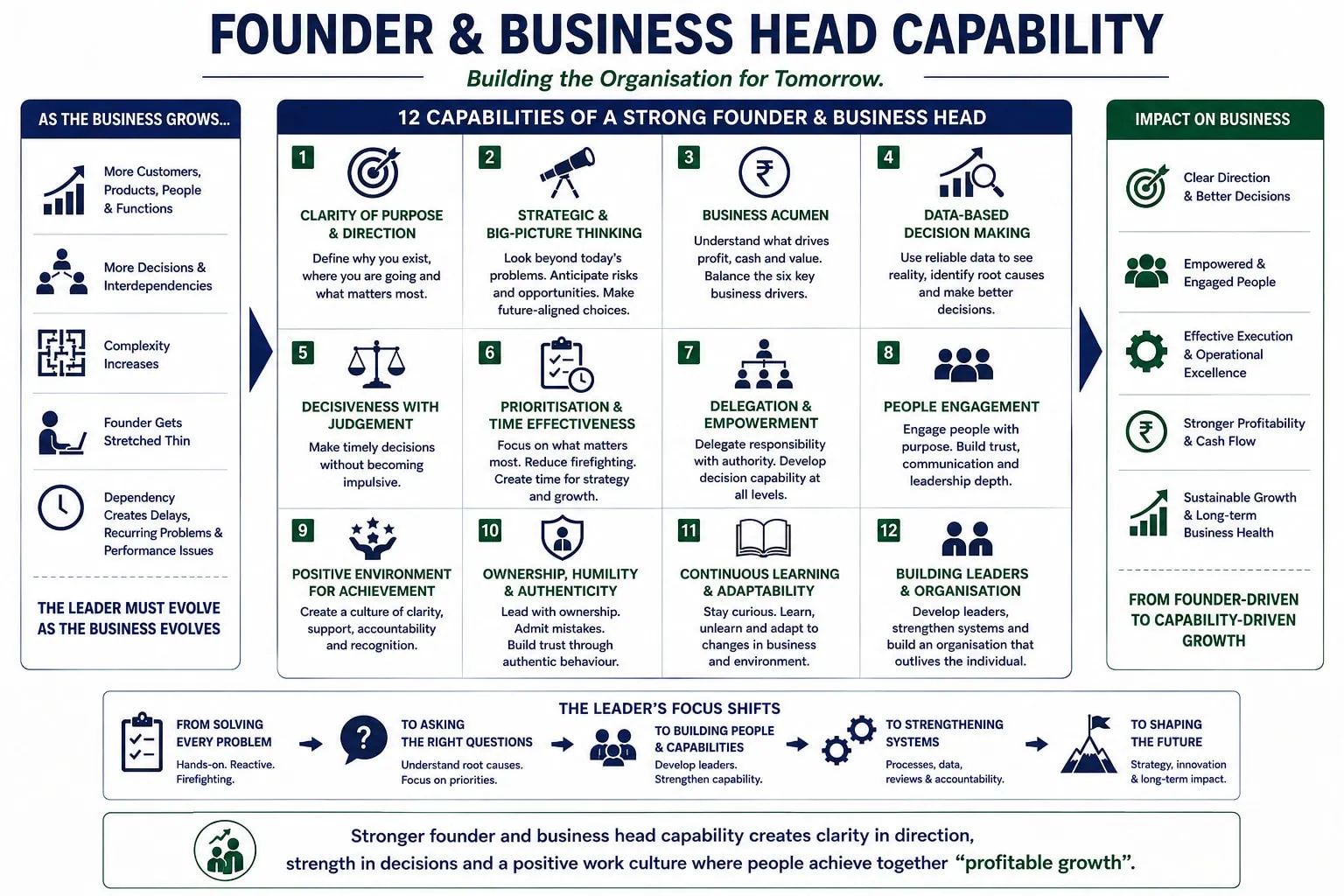
What are the 12 capabilities of a strong Founder or Business Head?
The person leading the business does not need to become an expert in every function. But the leader must develop the thinking, judgement and leadership capability required to guide the complete organisation.
These 12 capabilities help the founder or business head provide direction, understand the business, make stronger decisions, develop people and build an organisation that can achieve profitable growth together.
Clarity of Purpose & Direction
Does the organisation clearly understand where it is going and what matters most?
The business head must provide clarity on purpose, values, priorities and long-term direction. This clarity helps people connect their daily work with the larger goals of the business.
In practice- Communicate priorities consistently.
- Align short-term actions with long-term direction.
- Use values to guide difficult decisions.
Strategic & Big-Picture Thinking
Can the leader look beyond the immediate issue and see the wider business impact?
Strategic thinking helps the business head understand root causes, anticipate future needs and connect decisions across customers, people, operations, finance and growth.
In practice- Look beyond visible symptoms.
- Study recurring patterns and interdependencies.
- Create time for future-focused thinking.
Business Acumen
Does the leader understand how the business creates profit, cash and long-term value?
Business acumen means understanding customers, products, people, profitability, cash flow, operations and growth and how decisions in one area affect the others.
In practice- Know customer-wise and product-wise profitability.
- Understand margins, cash flow and working capital.
- Evaluate whether growth is creating real value.
Data-Based Decision-Making
Are important decisions supported by reliable facts?
Experience and intuition remain valuable, but reliable data helps the leader understand the real problem, reduce assumptions and improve the quality of business decisions.
In practice- Ask what the data is indicating.
- Review a few meaningful business indicators.
- Separate evidence from opinion during reviews.
Decisiveness with Judgement
Can the leader make timely decisions without becoming impulsive?
Strong decision-making requires clarity about risk, business impact and available information. The leader must know which decisions require deeper analysis and which can be taken quickly or delegated.
In practice- Separate high-risk and routine decisions.
- Set clear decision timelines.
- Review outcomes and correct course when needed.
Prioritisation & Time Effectiveness
Is the leader’s time being used on the issues that create the greatest business value?
The business head must distinguish between urgent activity and important leadership work. Continuous involvement in routine issues reduces the time available for strategy, people and future capability.
In practice- Identify repeated issues reaching the top.
- Reduce unnecessary approvals and follow-up.
- Protect time for people and strategic priorities.
Delegation & Empowerment
Are people receiving both responsibility and the authority required to deliver?
Delegation becomes effective when expectations, authority, resources, support and accountability are provided together. Empowerment helps people develop confidence and independent decision capability.
In practice- Clarify the expected outcome.
- Give appropriate decision authority.
- Review without unnecessarily taking back control.
People Engagement
Are people connected with business outcomes or only completing assigned work?
Engagement grows when employees understand the purpose of their work, feel respected, receive feedback and believe that their contribution and development matter.
In practice- Connect individual work with business outcomes.
- Listen to concerns and improvement ideas.
- Recognise contribution and support development.
Positive Environment for Achievement
Has the leader created the conditions in which people can perform with confidence?
A positive work environment combines clear expectations, timely support, openness, fair accountability and confidence to raise problems before they become serious.
In practice- Create both high expectations and high support.
- Make it safe to report risks and mistakes.
- Remove barriers that prevent people from achieving.
Ownership, Humility & Authenticity
Does the leader’s daily behaviour create trust?
People observe how the leader responds when something goes wrong. Taking ownership, inviting feedback, admitting gaps and keeping commitments builds credibility and openness.
In practice- Take responsibility before assigning blame.
- Invite honest feedback from the team.
- Ensure that behaviour matches stated values.
Continuous Learning & Adaptability
Is the leader continuing to learn as the business environment changes?
Markets, technology, customers and people expectations keep changing. The leader must remain curious, seek wider perspectives, learn from outcomes and adapt when required.
In practice- Create a regular learning habit.
- Seek perspectives from peers and mentors.
- Experiment, review and adapt.
Building Leaders & Organisation
Is the business becoming stronger beyond the continuous involvement of one individual?
The founder or business head must develop leadership depth, strengthen systems, clarify accountability and build an organisation capable of sustaining performance.
In practice- Develop capable second-line leaders.
- Build systems that support independent execution.
- Prepare the organisation for continuity and growth.
How do these 12 capabilities work together?
They are not isolated qualities. Together, they shape how the leader thinks, decides, develops people and builds the organisation.
Build clarity, strategic perspective, business acumen and a complete view of the organisation.
Use data, priorities and timely decisions to guide the business with greater confidence.
Delegate, empower, engage and create an environment where people can contribute fully.
Develop leaders, systems and capabilities that reduce dependency and support future growth.
What business impact can stronger leadership capability create?
The impact becomes visible through the way the organisation decides, executes and grows.
Stronger Founder & Business Head Capability creates clarity in direction, strength in decisions and a positive work culture where people achieve profitable growth together.
Different leadership situations
What changes for second-generation and professional business heads?
The leadership context may differ, but the responsibility remains the same: protect the strengths of the business, improve what is required and prepare the organisation for its next stage.
Founder & Business Head Capability is not limited to first-generation entrepreneurs. It is equally important for successors, family-business leaders, Managing Directors, CEOs and professional business heads.
Second-Generation and Family-Business Leaders
A second-generation leader enters a business with an established history, customers, employees, systems, relationships and family expectations.
The challenge is not simply to continue what already exists. The leader must understand what should be preserved, what should be strengthened and what must change.
Important leadership priorities- Understand the complete business before trying to change it.
- Build credibility through responsibility and results.
- Respect the strengths created by the earlier generation.
- Develop independent judgement rather than waiting for approval.
- Introduce change without creating unnecessary conflict.
- Prepare the business for the future while protecting its values.
Professional CEOs and Business Heads
A professional business head may not own the organisation, but carries responsibility for its overall health, performance and future.
The role requires an owner’s perspective. Functional success alone is not enough when the leader is responsible for the complete business.
Important leadership priorities- Balance short-term targets with long-term business health.
- Protect profitability, cash flow and customer trust.
- Think beyond the leader’s original functional expertise.
- Build leadership depth and organisational capability.
- Make decisions in the interest of the complete business.
- Create continuity beyond the tenure of any one individual.
What role does the founder or previous generation play?
The next leader can grow only when the previous leader creates the space, experience and trust required for independent leadership.
Help the next leader understand the business, its history and important relationships.
Give responsibility together with authority and room to learn from outcomes.
Remain available for guidance without taking back every important decision.
Move towards mentoring, strategy, relationships, culture and long-term continuity.
In Proven Path to Profitable Growth, I have described leadership transition in a family business as a shared journey of preparation, maturity and trust.
The next leader cannot become capable only by receiving instructions. Capability develops through real experience, decision-making, responsibility and learning from outcomes.
The previous generation also needs to evolve. Remaining relevant does not require remaining at the centre of every decision. The role can gradually move towards mentoring, strategic guidance, key relationships and protecting the values of the business.
A successful transition strengthens both the next leader and the institution.
Whether the leader is a founder, successor or professional CEO, the real capability lies in thinking for the complete business, developing people and building an organisation that can perform, grow and continue with confidence.
Reflect on your leadership
How can you assess your Founder & Business Head Capability?
Leadership capability becomes clearer when you look at what is happening around you, how decisions are made and how much the organisation continues to depend on your direct involvement.
The objective is not to judge whether you are a good or bad leader. It is to understand which area of your leadership currently needs greater attention.
How much of your time goes into daily problems?
Examine whether operational follow-up is reducing the time available for people, strategy and future growth.Which important decisions still depend only on you?
Identify where the organisation may be waiting for your approval, judgement or intervention.Do you understand what drives profit and cash?
Look beyond sales and examine margins, product mix, working capital, costs and asset effectiveness.Are important decisions supported by reliable data?
Review whether decisions are based on current facts or mainly on assumptions, memory and opinions.Have you delegated authority along with responsibility?
People cannot take ownership when they remain dependent on you for every important decision.Can your managers raise problems openly?
A healthy leadership environment allows risks and mistakes to surface early without fear or blame.Are people connected with business outcomes?
Examine whether employees understand how their work affects customers, profitability and growth.Are you developing leaders who can think independently?
Leadership depth develops when people receive real responsibility, experience and accountability.Do recurring problems repeatedly reach your level?
Repeated escalation may indicate unclear roles, weak systems or unresolved capability gaps.What are you learning for the next stage of the business?
Leadership capability must continue to evolve as the market, technology and organisation change.If you step away from the business for 30 days, what will stop working?
Your answer can reveal where systems are weak, where decisions remain centralised and where the organisation still depends excessively on your presence.
You may find that several areas require improvement. That is natural. Founder & Business Head Capability develops over time and changes as the business enters a new stage.
The immediate need is not to improve all 12 capabilities together. The priority is to identify which leadership gap is currently affecting the organisation most.
Clarity about the gap helps the leader move from general intention to focused action.
Where should you begin?
Start with the leadership issue that is creating the greatest constraint to performance or growth.
When too much depends on you
Focus on delegation, decision authority, leadership depth and the systems required for independent execution.
When sales grow but profit and cash remain weak
Strengthen business acumen, financial understanding, data quality and the discipline of reviewing business performance.
When the organisation remains in firefighting
Improve priorities, root-cause thinking, accountability and the capability required to prevent recurring problems.
Identify the leadership capability that needs greater attention
The PGCF Capability Assessment helps founders and business heads reflect on their present strengths, identify capability gaps and determine where focused improvement may be required.
Assess your business capabilitiesContinue the leadership journey
How can you strengthen your Founder & Business Head Capability?
Leadership capability does not develop through one programme or one decision. It develops as we learn from experience, reflect on our own leadership and consciously strengthen the areas required for the next stage of the business.
Explore related leadership insights
These topics can help you go deeper into individual areas of Founder & Business Head Capability.
Business Acumen
Understand the complete business beyond your own functional expertise.
Read related insight →Decision-Making
Improve the quality and speed of decisions as the organisation becomes more complex.
Read related insight →Delegation & Empowerment
Build ownership by giving people responsibility, authority and room to perform.
Read related insight →Leadership Practices
Strengthen the everyday practices through which leaders influence execution and people.
Read related insight →Leadership Mindset
Explore how the leader's way of thinking influences behaviour, decisions and organisational culture.
Read related insight →Building Leadership Depth
Develop capable leaders so that growth does not create greater dependency on the person at the top.
Read related insight →Proven Path to Profitable Growth
In my book, I have shared my learning from working with businesses and leaders, including leadership mindset, behaviour, business understanding and the capabilities required to build a stronger organisation.
How does this capability fit into PGCF?
Founder & Business Head Capability is one part of the Profitable Growth Capability Framework. Sustainable profitable growth requires the four capabilities to strengthen together.
Is your leadership evolving at the same pace as your business?
As businesses grow, the leadership challenges also change. Understanding where the business is still dependent on you and which capabilities need strengthening is an important step towards profitable growth.