
You will learn
Developing Business Acumen
Over the years, I have worked with many founders and business heads who are very capable in their own functional areas. Some are strong in manufacturing, some in technology, some in sales and others in product development.
But when they start taking responsibility for the complete business, functional expertise alone may not be sufficient.
I experienced this with a second-generation CEO of a machine-building company. He was technically very strong and had good knowledge of operations, design and development. However, he had very little exposure to the business’s P&L and cash flow.
When I asked him to start looking at the P&L, his immediate response was:
“I am not from a finance background. How can I understand P&L?”
I gave him a simple format and helped him understand how to interpret the different numbers. Within three months, he started putting together the numbers himself and, more importantly, started drawing useful business insights from them.
He began asking different questions.
Where are we not making the right margin? Why are some expenses high? Where can we control costs? How much is outsourcing really costing us? Would it make better business sense to bring some operations in-house?
Earlier, his attention was mainly on operations and supply chain. Once he began to understand P&L and cash flow, he started looking at the business more holistically.
His technical capability had not changed. What changed was his understanding of the complete business.
That, in my experience, is an important part of developing business acumen.
What does Business Acumen really mean for an SME founder or business head?
Business acumen is the ability to understand how the different parts of a business work together and how decisions made in one area affect overall business performance.
As a founder or business head, you do not need to become an expert in finance, sales, operations, supply chain, HR or every other function.
But you need to understand enough to ask the right questions, interpret the important numbers and make the right business decisions.
For example, an increase in sales may look positive. But as a business head, you should also be able to ask:
Is the additional business profitable? Are we generating enough cash from this growth? Do we have the capacity to deliver it? Will it increase inventory or receivables? Do we have the people capability to manage the additional business?
This is where business acumen becomes important.
It helps the leader move away from looking at each function in isolation and start seeing the connections among customers, products, people, operations, profitability, cash flow, and growth.
In my experience, this shift in thinking is particularly important for founders and business heads who have grown through one particular functional strength. As the business grows, it has to gradually expand its understanding beyond its own area of expertise.
Business acumen is not about knowing everything about the business. It is about understanding the business well enough to see the connections and make better decisions for the whole organisation.
Why does Business Acumen become more important as the business grows?
In the early stages of a business, the founder may personally know most customers, products, employees and day-to-day issues. Many decisions can be made based on direct involvement and experience.
As the business grows, this becomes increasingly difficult.
More customers and products get added. The team becomes larger. Working capital requirements increase. Investments become bigger. Different functions start taking independent decisions, and the impact of one decision may be felt somewhere else in the business.
At this stage, the founder or business head cannot look at the business only from the function in which he or she is most comfortable.
A technically strong leader may naturally focus more on products and operations. A sales-oriented leader may focus on revenue and customers. A finance-oriented leader may pay greater attention to costs and cash.
All these perspectives are important, but none of them alone represents the complete business.
As the person responsible for the organisation, the business head needs to connect them.
For example, a large customer order may look attractive from a sales perspective. But before accepting it, the business head may need to understand the margin, capacity requirement, additional investment, working capital, delivery risk and whether the organisation has the capability to execute it.
The question therefore gradually changes from:
“Is my function performing well?”
to:
“Is the complete business performing well, and are we building the capability required for the next stage of growth?”
In my experience, this shift from functional thinking to business thinking is an important part of leadership evolution.
What should a founder or business head understand about the whole business?
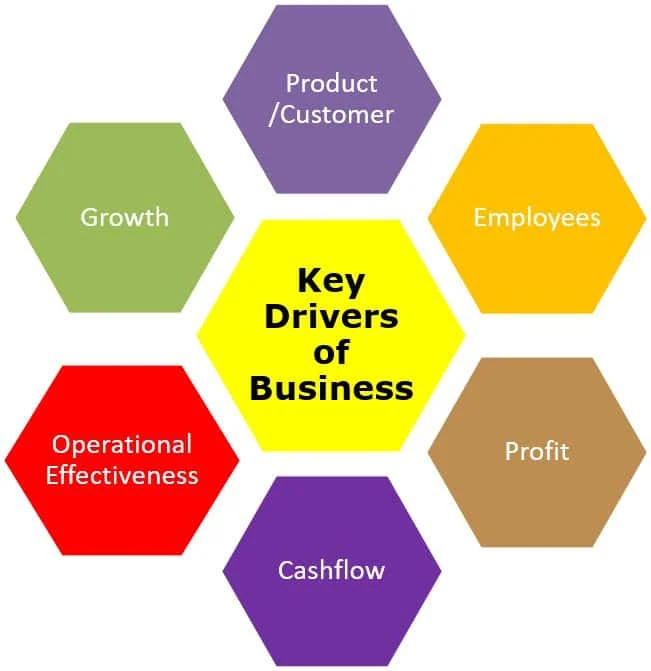
When I look at a business from a business head’s perspective, I find it useful to understand six important drivers.
They are:
Customers & Products → People → Profitability → Cash Flow → Operational Effectiveness → Growth
These drivers are interconnected.
A new customer may increase sales, but it can also increase capacity requirements, inventory and receivables. A new product may bring volume but may not generate the expected margin. Higher production may improve utilisation, but if the products are not profitable or customers do not pay on time, the business can still struggle with cash.
Similarly, growth cannot happen consistently without capable people and reliable operations.
That is why a founder or business head should not review these areas independently. The real value of business acumen comes from understanding how a decision in one area influences the others.
Let us look at each of these six drivers from the perspective of the person responsible for the complete business.
Are your customers and products creating real value?
Sales growth is important, but not every customer or product necessarily creates the same value for the business.
I experienced this at a casting company that had supplied one major customer for many years. The relationship was strong; the business kept growing, and the company continued to expand alongside the customer.
When we carried out a product volume and value analysis, a different picture emerged.
The company was highly dependent on one customer. We also found that some products were consuming valuable capacity without generating adequate returns. Some products required a price increase, while a few were not worth pursuing in their existing form.
This understanding changed the way the CEO looked at the business.
The company subsequently developed another customer, reducing its customer concentration risk. It also used the product volume and value analysis in discussions with the existing customer. This helped the company obtain price increases in some areas and move towards more attractive high-value, high-volume products.
The lesson was simple.
More sales or more volume does not automatically mean better business.
A founder or business head should therefore understand:
- Which customers and products are contributing to revenue and profit?
- Are we excessively dependent on a single customer, industry, or product?
- Which products are consuming significant capacity but giving inadequate returns?
- Where do we have an opportunity to improve price or product mix?
- Are we pursuing business because it creates value, or simply because it adds volume?
The objective is not to view customers solely from a sales perspective. It is to understand the quality of the business we are getting from them.
For a business head, customer understanding therefore goes beyond revenue. It should include customer concentration, product mix, margins, capacity utilisation, future potential, and risk.
Do you have the people capability required for the business to grow?
People are one of the most important drivers of business performance. Yet, from a business head’s perspective, understanding people goes beyond reviewing headcount or recruitment.
The real question is whether the organisation has the right people, skills and leadership capability to deliver today’s business and support tomorrow’s growth.
I have seen businesses invest in new machines, add capacity and pursue larger orders, only to find that the organisation is not ready to handle the increased complexity. Sometimes the constraint is not physical capacity. It is the availability of the right skills, supervisory capability, functional leadership or ownership at different levels.
A founder or business head therefore needs to understand questions such as:
- Do we have the right people in critical roles?
- Where are our major skill and capability gaps?
- Is employee productivity improving as the business grows?
- Are we losing capable people, and do we understand why?
- Do managers take ownership, or do most issues still come back to the founder or business head?
- Are we developing the next level of leaders required for future growth?
This does not mean that the business head should get involved in every recruitment, appraisal or people issue. Those responsibilities should remain with the appropriate leaders and functions.
But the person responsible for the entire business should understand whether people’s capability is becoming an enabler or a constraint on growth.
Some useful indicators, such as productivity, attrition, absenteeism, critical vacancies, and capability gaps, can provide visibility. But numbers alone may not tell the complete story. Regular interaction with people at different levels also helps the leader understand what is really happening inside the organisation.
As the business grows, people capability becomes increasingly important because business growth without corresponding growth in organisational capability eventually creates greater dependency on a few individuals.
For a business head, understanding people is therefore not merely an HR responsibility. It is an important part of understanding the business.
Do you really understand where your profit comes from?
Revenue tells us how much business we are doing. Profitability tells us whether that business is creating value.
I have come across businesses where sales continue to grow, machines remain busy, and people work hard, yet the expected profit does not materialise. When this happens, looking only at the overall profit percentage may not give the complete picture.
A business head needs to understand where the profit is coming from and where it is getting lost.
The machine-building CEO I mentioned earlier experienced this shift once he started interpreting his P&L. Instead of seeing finance as outside his area of expertise, he began viewing the numbers from a business perspective.
He started questioning where margins were inadequate, which expenses were increasing and what was driving those costs. He also examined the cost of buying certain items from outside and evaluated whether bringing selected operations in-house would make better business sense.
The P&L was no longer merely a financial statement for him. It became an input for business decisions.
A founder or business head should therefore have clarity on questions such as:
- Which customers and products are contributing to our profit?
- Are our margins improving or declining, and why?
- What are the major costs affecting profitability?
- What is our break-even level?
- Are price increases keeping pace with changes in material and other input costs?
- Are we making the right make-or-buy decisions?
- Are our investments and resources generating adequate returns?
The objective is not for the founder or business head to become an accountant.
The objective is to understand the important numbers well enough to question them, connect them with what is happening in the business and take appropriate action.
For example, a decline in margin may originate from higher material cost, poor pricing, lower productivity, rejection, an unfavourable product mix or underutilised capacity. The number becomes useful only when the leader understands what is driving it.
That is why I believe every business head should be comfortable reading the P&L and understanding the business’s basic economics.
You do not need a finance background to understand profitability. But if you are responsible for the entire business, you need to know whether the business you are growing is actually profitable.
Is your business generating cash or only reporting profit?
A business can report profit and still struggle to meet its day-to-day cash requirements.
This is something every founder and business head needs to understand.
As the business grows, more money may get locked in inventory, receivables and other working-capital requirements. Sales may increase, and the P&L may show a profit, but if customers take longer to pay or inventory continues to increase, the business can still face a cash shortage.
That is why I believe a business head should look beyond the profit number and understand how cash is moving through the business.
Some important questions are:
- How much money is locked in inventory?
- How many days are customers taking to pay us?
- Are our receivables increasing faster than sales?
- Are we buying or producing more than what the business really requires?
- Are supplier payment commitments aligned with customer collections?
- How much working capital is required to support the next stage of growth?
- Are new investments putting pressure on cash?
- Is the business generating enough operating cash to support its growth?
This understanding becomes even more important when the business is expanding.
For example, imagine that sales grow from ₹50 crore to ₹70 crore. On the surface, this looks positive. But if the additional ₹20 crore of business requires significantly higher inventory, longer customer credit and additional capacity investment, the founder needs to understand how that growth will be funded.
Otherwise, growth itself can create financial pressure.
This is why reviewing only the bank balance is not enough. The business head should understand the movements of receivables, inventory, payables, working capital, and operating cash flow, and how business decisions influence them.
Again, this does not mean that the founder or business head needs to become a finance specialist. The finance team can prepare the statements and provide the analysis.
But the business head must be able to look at those numbers and ask:
Where is our cash getting locked up, why is it happening, and what business decision is required to improve it?
That is business acumen.
Profitable growth should ultimately strengthen the business’s cash-generating ability, not continuously increase its dependence on additional funding.
How effectively is your business converting resources into customer value?
A business may have good products, sufficient orders and capable people. But ultimately, it has to convert its resources into products or services that reach the customer at the right quality, cost and time.
This is where operational effectiveness becomes important.
In many businesses, operational problems first become visible through delayed deliveries, high inventory levels, quality issues, excessive overtime, frequent expediting, or continuous firefighting. The immediate tendency may be to treat each of them as a separate problem.
But from a business head’s perspective, these are often signals of deeper capability gaps.
For example, poor delivery performance may not necessarily be a production problem alone. It could originate from unrealistic sales commitments, inadequate capacity planning, material shortages, supplier issues, quality problems, poor coordination or even cash-flow constraints.
Similarly, a machine running continuously does not necessarily mean that the business is productive. If it is producing the wrong product, creating excess inventory or generating rejection, utilisation alone has little meaning.
A founder or business head should therefore understand questions such as:
- Are we consistently meeting customer delivery commitments?
- Where are we losing capacity and productivity?
- Is inventory increasing because of genuine business requirements or because of poor planning?
- What are the major causes of rejection, rework and operational losses?
- Are our suppliers meeting the reliability requirements of the business?
- Are we using our existing capacity effectively before investing in additional capacity?
- Are recurring operational problems being solved at the root cause, or are they repeatedly managed through firefighting?
Measures such as On-Time Delivery (OTD), Overall Equipment Effectiveness (OEE), productivity, rejection rate, inventory turns, capacity utilisation, and supplier performance can provide useful visibility.
But the role of the business head is not simply to review more KPIs.
The important question is:
What are these numbers telling me about the capability of my business to execute consistently?
This distinction is important.
If OTD is poor, the leader should not merely ask the production team to improve the percentage. The leader needs to understand which organisational capability is preventing the company from honouring its customer commitments.
If OEE is low, the discussion should not stop with the OEE number. The real value comes from understanding where capacity is being lost and what needs to change to recover it.
That is how operational measures become business information rather than merely functional data.
As the business grows, operational effectiveness also determines how much growth can be achieved with existing resources before adding more people, machines, inventory, or investment.
For a business head, operational effectiveness is therefore not about knowing every operational tool. It is about understanding whether the organisation can reliably convert its resources into customer value and profitable business.
Is your growth sustainable and profitable?
Every business wants to grow.
More customers, higher sales, new products, additional capacity and expansion into new markets are all signs of growth. But as I have seen in many businesses, growth by itself does not necessarily make the business stronger.
Sometimes sales grow while margins decline.
Sometimes additional orders increase inventory and receivables faster than cash generation.
Sometimes new capacity is added before the existing capacity is effectively utilised.
And sometimes the organisation grows faster than its people and systems can handle, leading to more firefighting and greater dependence on the founder.
This is why a business head needs to look at growth from a broader perspective.
Before pursuing the next stage of growth, some important questions are:
- Is the additional business giving us the right margin?
- Which customers, products and markets should we grow?
- Do we have the operational capacity to support the growth?
- How much additional working capital will be required?
- Do we have the people and leadership capability to manage a larger organisation?
- What investment will be required, and what return can we expect?
- Are we becoming excessively dependent on a single customer, product, or market?
- What new risks are we creating as the business becomes larger?
These questions do not mean that the leader should become overly cautious about growth.
They help the leader understand what kind of growth is right for the business and whether the organisation is ready for it.
The casting-company experience I shared earlier is a good example. The company had been growing along with one major customer. But once we looked more deeply into customer concentration, product value, volume, and capacity consumption, it became clear that not all growth was equally valuable.
That understanding helped the CEO make different choices about customers, products, pricing and capacity.
This is where all the dimensions of business acumen come together.
A growth opportunity cannot be evaluated only from a sales perspective. The business head needs to connect:
Customers & Products → People → Profitability → Cash Flow → Operational Effectiveness → Growth
Each one influences the others.
A leader with good business acumen begins to see these connections before making important decisions.
The real question is not simply, “How much can we grow?”
The better question is, “How can we grow in a way that makes the business more profitable, capable and sustainable?”
That, in my experience, is the difference between pursuing growth and building a business for profitable growth.
How can a founder or business head develop Business Acumen?
Business acumen develops when a leader consciously looks beyond their familiar area and begins to understand how the entire business works.
It does not happen overnight.
The machine-building CEO I mentioned earlier did not become financially knowledgeable by attending a finance programme. He started with a simple P&L format, understood what each number meant and gradually connected those numbers with what was actually happening in his business.
Within a few months, the numbers started making sense because he was relating them to decisions he was already making.
In my experience, founders and business heads can develop business acumen through a few regular practices.
1. Step outside your functional comfort zone
Most leaders naturally spend more time in areas where they have greater knowledge and confidence.
If you come from manufacturing, spend time understanding sales, customers and finance. If your strength is sales, understand operations, capacity, costs and cash flow. If you come from finance, spend time understanding products, customers and people.
You do not need to master every function. But you should understand enough to see how they connect.
2. Review the P&L and cash flow regularly
Do not leave financial understanding entirely to the finance team.
Start with a simple view of revenue, material cost, contribution, operating expenses, profitability, receivables, inventory, payables and cash flow.
More importantly, ask why the numbers are changing.
If margin has declined, what caused it?
If sales have increased but cash has reduced, where has the money gone?
If expenses have increased, is the increase supporting growth or simply adding cost?
Over time, this habit develops a much stronger understanding of the business’s economics.
3. Understand your customers and products beyond sales
Do not stop with the question, “How much are we selling?”
Understand which customers and products generate value, which consume disproportionate capacity, where margins are inadequate and where concentration risk exists.
The casting company experience we discussed earlier changed once the CEO began viewing the business in terms of product volume and value rather than sales alone.
The quality of business is as important as the quantity of business.
4. Connect operational decisions with financial outcomes
Many operational decisions ultimately manifest in the business’s financial performance.
High rejection affects margin.
Excess inventory locks cash.
Poor productivity increases cost.
Delayed delivery can affect customer confidence and future sales.
Poor capacity utilisation may lead to unnecessary investment.
When leaders start making these connections, functional numbers begin to become business information.
5. Ask better questions during reviews
A business head does not have to provide every answer.
Sometimes the quality of leadership comes from asking the right questions.
Instead of asking only:
“Why did we miss the target?”
ask:
“What is preventing us from achieving it consistently?”
Instead of:
“Do we need another machine?”
ask:
“How effectively are we using the capacity we already have?”
Instead of:
“How can we increase sales?”
ask:
“Which customers and products should we grow profitably?”
Better questions gradually improve both the leader’s understanding and the quality of thinking across the organisation.
6. Spend time where the business actually happens
Reports and dashboards are useful, but they cannot replace direct understanding.
Meet customers. Visit the shop floor. Speak with functional leaders. Understand supplier concerns. Review customer complaints. Spend time with the finance team when required.
These interactions help the business head connect the numbers with what is actually happening.
7. Learn from important business decisions
Some of the best learning comes from decisions already taken.
After an important investment, new customer acquisition, product launch, price revision or capacity expansion, look back and ask:
What did we expect? What actually happened? What did we miss? What should we do differently next time?
This habit gradually strengthens judgement.
Business acumen, therefore, develops through a combination of numbers, observation, questions, experience, and reflection.
The objective is not to know everything.
The objective is to understand the business well enough to ask better questions, see the connections, and make better decisions.
Where does Business Acumen fit within the Profitable Growth Capability Framework (PGCF)?
Through my consulting work with SME founders and business heads, I have increasingly realised that sustainable growth depends on the capabilities we build within the business.
This thinking led me to develop the Profitable Growth Capability Framework (PGCF).
Within PGCF, Business Acumen is an important part of Founder & Business Head Capability. As the person leading the business, the founder or business head needs to understand how customers, products, people, operations, profitability, cash flow and growth influence one another.
This understanding improves the quality of decisions at the top. It also helps the leader look beyond individual functional performance and understand what is required for the businessas a whole to become stronger.
Business acumen alone, however, cannot create profitable growth. The organisation also needs strong Leadership & Organisation Capability, Business Execution Capability, and Scaling & Growth Capability. Together, these capabilities influence overall business performance.
Business acumen helps the leader see the complete business. PGCF helps the leader understand the capabilities required to strengthen it.
How strong is your Business Acumen today?
Business acumen develops continuously as the business grows and the leader takes on greater responsibility.
A simple way to reflect on your present level of business understanding is to ask yourself:
- Do I know which customers and products are really creating value for my business?
- Do we have the people and leadership capability required for our next stage of growth?
- Can I comfortably read my P&L and explain what is driving changes in profitability?
- Do I understand where cash is getting generated and where it is getting locked?
- Do I know the major operational losses affecting our delivery, productivity, quality and capacity?
- When I look at a growth opportunity, can I connect sales potential with margin, cash, capacity, people, investment and risk?
You may be very strong in some of these areas and less comfortable in others. That is quite natural.
The important point is to recognise where your understanding needs to improve.
The second-generation machine-building CEO I mentioned at the beginning did not need to become a finance professional. Once he understood how to read the P&L and connect the numbers with his operational knowledge, his perspective on the business became much broader.
Similarly, the casting-company CEO was already growing his business. The change came when he started looking beyond sales volume and began to understand customer concentration, product value, capacity utilisation, and profitability together.
Both experiences reinforced one learning for me.
The quality of a business decision improves when the leader can see the connections across the business.
As your business grows, your role also needs to evolve. You may have built the business through your technical knowledge, customer relationships, operational strength or entrepreneurial instinct. Those strengths remain valuable.
But the responsibility of leading the complete business requires a broader understanding.
You do not need to have all the answers.
You need to know what questions to ask, what numbers to understand, where to look deeper and how one decision can influence the rest of the business.
That is how Business Acumen develops.
And that is how a founder or business head gradually moves from being strong in a particular function to thinking and acting as the leader of the complete business.
reflect on
Which part of your business do you understand the least today?
Perhaps that is the right place to begin strengthening your Business Acumen.