
Leadership & Organisation Capability
Leadership bandwidth, organisation structure, role clarity, people capability, accountability and culture must evolve to handle increasing scale and complexity.
Leadership & Organisation Capability is about building an organisation that can take greater ownership, work together effectively and support the next stage of profitable growth.
Why Must Organisation Capability Grow Along With the Business?
In the early stages of a business, the founder and a few key people can manage most things directly.
They know the customers, people and operations closely. Decisions are faster. Problems can be resolved through personal involvement. Even if systems are not fully established, the business can still move forward.
But this way of working has its limitations as the business grows.
More customers bring more commitments. More people require greater clarity and coordination. More functions create interdependencies. More business also means more decisions, reviews and follow-up.
I have seen businesses where market opportunities and sales grew faster than the organisation's ability to handle them. The same few people continued to carry too many responsibilities. Roles became unclear. Decisions moved upwards. Coordination between functions became difficult. Firefighting increased.
The business may still be growing in sales, but the organisation starts getting stretched.
This is where growth can start putting pressure on profitability.
What Is Leadership & Organisation Capability?
Leadership & Organisation Capability is the ability of the organisation to take greater responsibility and handle increasing business complexity as it grows.
It goes beyond having a few capable people at the top.
The organisation needs clear roles and accountability, capable leaders at different levels, effective delegation, faster decision-making, the right people, stronger collaboration and a culture that supports performance.
It also needs systems and review mechanisms that bring clarity and discipline without making the organisation bureaucratic.
The organisation becomes less dependent on a few individuals
People know what they are responsible for
Decisions happen at the right levels
Functions work together with greater ownership
What Capabilities Must Grow Along With the Business?
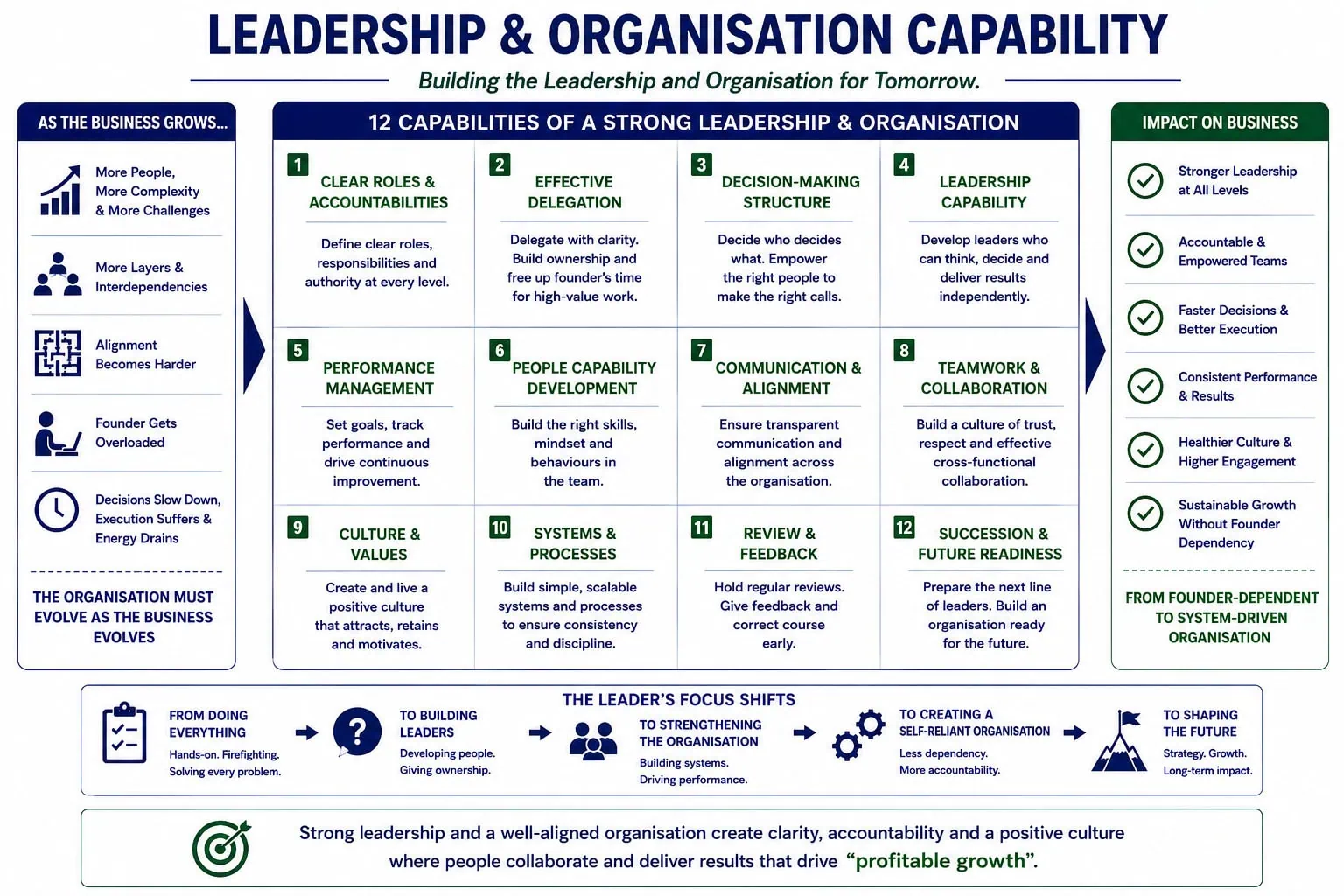
As the business grows, these 12 capabilities help the organisation take greater ownership, make better decisions, work together and handle increasing complexity.
Clear Roles & Accountabilities
As the organisation grows, responsibilities can easily become blurred. People need clarity on what they own, what results are expected and where accountability rests.
Define roles around business outcomes, not just activities. Ensure important responsibilities have clear ownership.
Effective Delegation
Delegation is not simply giving more work to people. Responsibility must move along with the authority required to deliver it.
Identify responsibilities and decisions that no longer need to remain at the top. Give capable people the authority to act and review outcomes without getting back into day-to-day control.
Decision-Making Structure
As the organisation grows, every decision cannot travel upwards. This slows execution and keeps the leadership team overloaded.
Clarify which decisions belong at which level. Define appropriate authority limits and clear escalation mechanisms for decisions that need senior attention.
Leadership Capability
Growth requires capable leaders beyond the founder and a few senior people. Managers must increasingly lead people, solve problems and take responsibility for results.
Identify critical leadership positions, assess capability gaps and consciously develop the second and third line.
Performance Management
People perform better when expectations and outcomes are clear. Performance management should bring focus and accountability, not become an annual appraisal exercise.
Establish meaningful business, functional and individual KPIs. Review performance regularly and connect discussions with actions, support and accountability.
People Capability Development
Today's team may be adequate for today's business. The question is whether they are capable of handling tomorrow's business.
Look ahead at the capabilities the business will need. Identify gaps, develop existing people and recruit externally where required.
Communication & Alignment
As more people and functions are added, informal communication is no longer enough. People need clarity on priorities, changes and expectations.
Create regular communication forums across levels so important information moves quickly and people remain aligned with business priorities.
Teamwork & Collaboration
Business performance cannot come through individual functional excellence alone. Functions become increasingly interdependent as the organisation grows.
Break functional silos. Use cross-functional teams for important business priorities and create shared ownership for outcomes.
Culture & Values
As the founder becomes less involved in every activity, people need a common understanding of how the organisation expects them to work, decide and behave.
Make values visible through leadership behaviour, decisions, recognition and everyday practices. Culture should be experienced in how the organisation works.
Systems & Processes
A growing organisation cannot continue depending on individual memory, experience and personal follow-up. Important ways of working need consistency and repeatability.
Identify critical business and management processes, define simple ways of working and ensure systems enable people rather than create unnecessary bureaucracy.
Review & Feedback
Good execution needs a rhythm of review, learning and correction. Reviews should help teams identify risks, solve problems and improve performance.
Establish appropriate daily, weekly and monthly review rhythms. Keep reviews focused on performance gaps, risks, decisions and actions rather than status reporting.
Succession & Future Readiness
Organisation capability should not be built only for today's requirements. Growth creates new roles, larger responsibilities and future leadership needs.
Identify critical positions and future leadership requirements early. Build internal successors where possible and reduce dependence on any one individual.
Understand where the organisation is getting stretched today. Identify the few capabilities restricting the next stage of growth and strengthen them systematically.
How Do These Organisation Capabilities Work Together?
An organisation does not become stronger by improving one capability in isolation.
Role clarity helps people understand what they own. But without delegation, they may still wait for decisions from the top.
Delegation gives people responsibility. But without the right capability and review mechanisms, execution may become inconsistent.
Good systems and processes bring discipline. But without leadership, communication and collaboration, functions can still work in silos.
Similarly, performance measures create visibility. But without accountability, feedback and corrective action, they may remain only as numbers.
This is why I look at Leadership & Organisation Capability as an interconnected system.
Is Your Organisation Ready for the Next Stage of Growth?
Organisation capability gaps are not always visible when the business is small. The real test comes when the business starts growing.
More orders, more customers and more people can expose weaknesses that were manageable earlier. What appears to be a manpower issue may actually be a role clarity problem. What appears to be slow execution may be a decision-making or delegation problem. Frequent firefighting may indicate weak systems, reviews or leadership capability.
A CEO should therefore periodically ask:
Can my leadership team run their functions without depending on me for routine decisions?
Are roles, responsibilities and accountabilities clear across the organisation?
Are decisions being taken at the right level, or are too many decisions still coming upwards?
Do we have capable second-line leaders who can take greater responsibility as the business grows?
Are our KPIs and reviews actually improving performance, or are we only reviewing numbers?
Are functions working together towards business outcomes, or are functional silos affecting execution?
Are we developing people for future business requirements, or only solving today's manpower problems?
Are our systems and processes helping people execute consistently without constant follow-up?
Does our culture encourage ownership, accountability, collaboration and problem-solving?
If the business grows another 30% to 50%, can the present organisation handle it without significantly increasing firefighting and founder involvement?
The 30-Day Test
If you step away from the business for 30 days, will the organisation continue to operate, make decisions, serve customers and deliver results effectively?
How Can You Strengthen Your Leadership & Organisation Capability?
Organisation capability does not develop by adding more people or introducing more controls. It develops by consciously strengthening the organisation as the business grows, so that people, leaders and systems can take greater responsibility.
Explore Related Leadership & Organisation Insights
These topics can help you go deeper into the areas that build a stronger, more capable organisation.
Organisation Structure & Role Clarity
Build an organisation where people understand their roles, responsibilities, authority and expected outcomes as the business grows.
Read related insight →Delegation & Decision-Making
Move appropriate responsibilities and decisions closer to where the work happens, without losing accountability or control.
Read related insight →Leadership & People Development
Develop capable leaders and people at different levels so that increasing business complexity does not remain dependent on a few individuals.
Read related insight →Performance & Review Systems
Create clear performance measures and effective review rhythms that help people identify gaps, take action and improve results.
Read related insight →Communication, Culture & Collaboration
Build an environment where people communicate openly, work across functions and take ownership of common business outcomes.
Read related insight →Organisation & Future Readiness
Strengthen critical systems, processes and leadership depth so that the organisation can handle the next stage of growth with less individual dependency.
Read related insight →How Does Leadership & Organisation Capability Support Profitable Growth?
As organisation capability improves, the business becomes better equipped to handle increasing scale and complexity without creating the same level of pressure on the founder, leadership team and people.
Faster Decisions
Decisions move to the right levels and execution does not wait unnecessarily for the top.
Stronger Execution
Clear roles, systems and reviews improve consistency and reduce repeated follow-up.
Greater Leadership Bandwidth
The founder and senior leaders get more time to focus on customers, growth and future priorities.
More Ownership
People take greater responsibility and contribute more effectively to business outcomes.
Leadership & Organisation Capability in PGCF
Leadership & Organisation Capability is one of the four interconnected capabilities within the Profitable Growth Capability Framework.
It helps convert business direction into ownership, accountability, coordinated decisions and organisational alignment.
But profitable growth becomes sustainable when this capability develops together with Founder & Business Head Capability, Business Execution Capability and Scaling & Growth Capability.