
Building delivery capabilities :
Why Do Some Organizations Consistently Deliver on Time (OTD) While Others Continue to Struggle?
Whenever I meet a founder or CEO, I ask one simple question.
“How consistently are you meeting your customer delivery commitments?”
Most do not answer with a percentage.
They simply smile and say,
“Most of the time.”
That answer tells me that On-Time Delivery depends more on daily firefighting than on organisational capability.
Over the past three decades, I have worked with many manufacturing organisations. One pattern has remained remarkably consistent.
The organisations that achieve consistently high On-Time Delivery are not necessarily those with the best machines, the largest factories or the biggest workforce.
They are the organisations that have deliberately built the capabilities required to honour every customer commitment.
Every CEO wants to improve On-Time Delivery (OTD).
- Sales teams work hard to win orders.
- Planning coordinates production schedules.
- Purchase follows up with suppliers.
- Production works to meet daily targets.
- Quality, logistics and other support functions contribute their part.
- Review meetings are conducted regularly.
Yet many organisations continue to struggle with delivery performance.
They struggle because the organisation has not built the capabilities required to deliver consistently.
That is the important distinction.
Many organisations focus on improving OTD.
Very few focus on building Delivery Capability.
When Delivery Capability becomes stronger, consistently high OTD is no longer achieved through firefighting.
It becomes the natural outcome of a well-managed organisation.
This paper explains the eight organisational capabilities I have found essential for achieving consistent On-Time Delivery.
What exactly is On-Time Delivery(OTD)?
On-Time Delivery answers one question.
Did we fulfil our delivery commitment to the customer as promised, in terms of date and Quantity?
Every customer order carries a commitment as a due date and Quantity.
Whatever the commitment, the customer expects the organisation to honour it.
OTD measures how consistently that promise is fulfilled.
In simple words,
OTD is a measure of execution reliability.
It tells us whether customers can trust our commitments.
Many organizations consider OTD as just another operational KPI.
In reality, it is much more than that.
It is one of the strongest indicators of organizational discipline and operational effectiveness.
Why does OTD matter so much to customers and for the organisation?
Every customer plans their business based on the supplier’s delivery commitment.
When one supplier fails to deliver on time, the disruption does not stop there.
The customer’s entire plan is collapsing, and their potential sales are being affected.
But when delays become frequent, something much more serious happens.
The customer slowly begins to lose confidence in your organisation, and data on your past delivery performance pushes them to reduce their share of business with your organisation, with some customers turning to alternative suppliers. You are losing their Trust and sales orders. Eventually, you lose your sales growth momentum, spend time acquiring another customer, and the cycle repeats.
That is when your business future becomes vulnerable.
OTD and Delivery Schedule Achievement are not the same
One common misunderstanding I often observe is that organisations use “Delivery Schedule Achievement” and “On-time delivery (OTD)” interchangeably.
Although both relate to delivery performance, they measure two different things.
Let us understand this through a simple example.
Suppose a customer places an order for 100 components to be delivered on 30th June.
The organization manages to dispatch only 70 components on 30th June.
The remaining 30 components are dispatched five days later.
Now let us interpret the performance.
From a delivery schedule perspective,
70 out of 100 components were delivered as planned.
Therefore, Delivery Schedule Achievement is 70%.
However, from the customer’s perspective, the original commitment was not fulfilled.
The customer expected the complete order.
Only part of the order arrived.
Therefore, this purchase order is treated as not delivered on time.
Its OTD score becomes 0.
Now consider another purchase order.
The customer ordered 100 components.
All 100 components reached exactly on the committed date.
Delivery Schedule Achievement is 100%.
OTD is also 100%.
Now let us take five purchase orders.
Purchase Order | Commitment Met | OTD Score |
PO 1 | Yes | 1 |
PO 2 | No | 0 |
PO 3 | Yes | 1 |
PO 4 | Yes | 1 |
PO 5 | No | 0 |
Out of five purchase orders,
Three met the delivery commitment.
Therefore,
OTD = 3 ÷ 5 = 60%.
This method may appear stricter.
In reality, it reflects the customer’s experience much better.
Customers do worry about whether each commitment was honoured.
Why measuring OTD this way changes organisational behaviour?
When OTD is measured order by order, every customer commitment becomes important.
Teams stop thinking only about dispatch quantity.
They begin thinking about commitment date or reliability.
When the team considers both quantity and due date, the priority becomes clearer and cross-functional coordination strengthens.
That clarity encourages better organizational discipline.
I have observed in many small and emerging organisations that the team is not aware of the “DUE DATE” or “Committed date”, but they place more importance on the PO date, SO date, and WO date. That shows the organisational lack of awareness of OTD.
I remember working with a fabrication company that served multiple customers. Although the plant had sufficient capacity to meet the requirements of all its customers, the management’s attention was almost entirely focused on one large-volume customer.
The reason was simple. That customer had a stringent penalty clause for delayed deliveries.
As a result, the team worked relentlessly to honour that customer’s commitments, while deliveries to other customers received far less attention.
To address this, we introduced a simple but powerful review mechanism: customer-wise delivery schedule actualisation and On-Time Delivery (OTD) percentage. Every customer’s delivery performance became visible and was reviewed regularly.
The moment performance became visible, awareness increased. Priorities changed. Accountability improved.
Within just three months, customer-wise delivery actualisation improved significantly—from around 60% to over 95%across customers.
That is the power of measuring the right performance indicator. What gets measured, reviewed, and discussed consistently improves.
The biggest misconception about OTD
Many organizations believe OTD belongs to the Production Department.
Whenever deliveries are delayed, production is the first department questioned.
Although production certainly plays an important role, it is only one part of a much larger system.
A customer order travels through many organizational processes before it reaches dispatch.
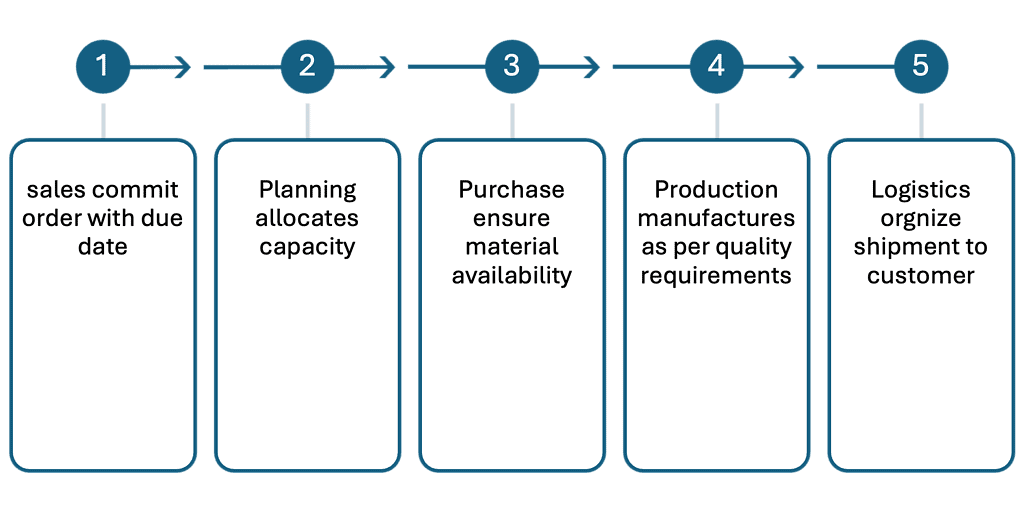
One weakness anywhere in this chain can delay the final delivery.
Therefore, OTD should never be viewed as a production KPI.
It is an organizational capability indicator.
That single shift in thinking changes everything.
Instead of asking,
“Why did Production fail?”
The better question becomes,
“Which organizational capability failed?”
That is where meaningful improvement begins.
A common pattern I have observed
Whenever I visit organizations struggling with OTD, I rarely find one single major problem.
Instead, I find several small weaknesses working together.
- Capacity planning is weak.
- Machine losses remain unresolved.
- Planning changes every day.
- Suppliers are unreliable.
- Quality issues consume valuable time.
- Review meetings focus only on delayed orders.
Each problem appears manageable on its own.
Together, they quietly destroy delivery reliability.
That is why improving OTD should never become a departmental project.
It should become an organizational capability-building journey.
When one capability becomes weak, delivery performance starts becoming unpredictable.
When several capabilities weaken simultaneously, firefighting becomes the standard way of working.
Let us understand these delivery capabilities one by one.
Eight Organizational Capabilities Behind Consistent On-Time Delivery
Many organizations ask,
“What should we do to improve our OTD?”
Over the years, I have found that this is not the most useful question.
The better question is,
“What capabilities must our organization build so that high OTD becomes a natural outcome?”
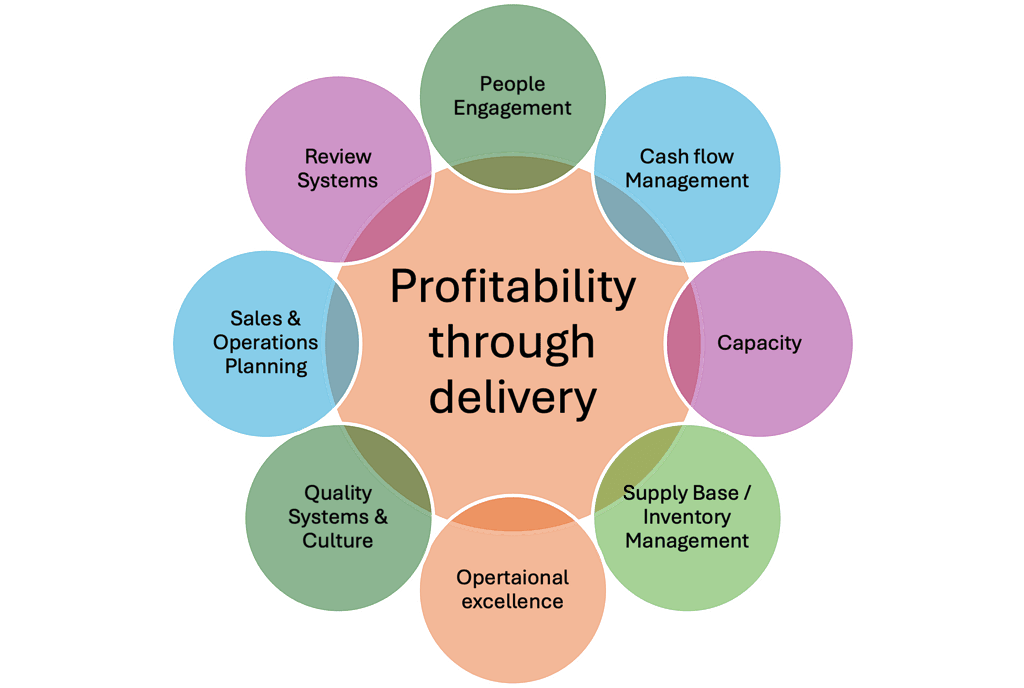
Capability 1: Capacity Management – Do you really know your capacity?
One question I often ask CEOs is,
“What is your actual production capacity?”
Most of them answer immediately.
Then I ask,
“How did you arrive at that number?”
That is where the discussion usually becomes interesting.
In many engineering companies, capacity is not a fixed number.
Every month the product mix changes.
Batch sizes change.
Component sizes change.
Processing time changes.
In one month, you may produce 500 large fabricated parts.
Next month, you may produce 2,000 smaller components.
But the actual capacity is completely different.
Unfortunately, many organisations continue accepting customer orders without understanding this changing capacity.
I remember one of my clients who was consistently struggling to achieve OTD.
Every review meeting ended with the same conclusion.
“Production could not meet the schedule.”
Initially, everyone believed production planning was the problem.
When we analysed the complete process, we discovered something surprising.
Neither the Sales team, nor the Production team, nor even the CEO had any reliable estimate of the actual powder coating capacity.
Because the product mix kept changing every month, nobody knew how much work the plant could genuinely absorb.
Sales was accepting orders based on optimism.
Production was trying to deliver through overtime and constant rescheduling.
The organisation was unknowingly committing beyond its capability.
To address this, we developed an Equivalent Capacity (Eq. Capacity) method.
Instead of looking at the number of components, we converted different products into a common equivalent unit based on the actual loading on the powder coating process.
For the first time, the leadership team could compare monthly demand with the plant’s real capacity.
The results were an eye-opener.
They realised that, for several months, they had been accepting orders well beyond what the powder coating facility could realistically handle.
The organisation had been making commitments beyond its capability.
That single insight changed the way the company planned its business.
The management approved investment in an additional powder coating plant.
More importantly, they began reviewing Equivalent Capacity every month and quarter before accepting future commitments.
Delivery planning became realistic.
Customer commitments became more reliable.
OTD started improving—not because people worked harder, but because the organisation finally understood its own capacity.
That is the real purpose of capacity management.
It is not about calculating machine hours.
It is about knowing, with reasonable confidence, what the organisation can genuinely deliver before making a promise to the customer.
What should the CEO do?
Before discussing delayed deliveries, ask these questions:
- Do we really know the actual capacity of every critical process?
- Is that capacity reviewed whenever the product mix changes?
- Are delivery commitments based on measured capacity or assumptions?
- Which process is currently constraining our overall delivery performance?
- Are our capacity reviews helping us make better business decisions, or are they simply reporting utilisation?
Organisations that understand their real capacity make realistic commitments.
Organisations that work with assumptions spend their time explaining delays to customers.
Capability 2: Operational Excellence – Are you fully utilising the capacity you already have?
One conversation that I frequently have with CEOs goes like this.
“We are unable to meet customer deliveries.”
“We need one more machine.”
Whenever I hear this, I rarely recommend an immediate investment.
Instead, I ask one simple question.
“How effectively is your existing equipment being utilised?”
In many small and emerging manufacturing organisations, this question is difficult to answer.
Not because the machines are not running.
But because equipment losses are not measured in a structured manner.
Even when Overall Equipment Effectiveness (OEE) is reported, the interpretation is often limited to a percentage on a dashboard.
Very little attention is given to understanding why the equipment is losing productive capacity.
- Human resources shortage
- Frequent changeovers.
- Minor stoppages.
- Speed losses.
- Waiting for materials.
- Waiting for tools.
- Quality rejections.
- No workload
Each loss appears small when viewed individually.
Collectively, they silently consume a significant part of the available capacity.
Unfortunately, because these losses remain invisible, management often concludes that the factory has reached capacity.
In reality, the factory has reached the end of its productive utilisation.
I experienced this in one of my clients in the packaging industry.
The company was growing, and customer demand was increasing.
Deliveries were becoming difficult to manage.
The leadership team was seriously evaluating a major capital investment for additional equipment.
When we assessed the plant, the Overall Equipment Effectiveness was only 20%.
Instead of recommending a new machine, we focused on understanding where productive capacity was being lost.
A structured improvement programme was launched to reduce equipment losses, improve operating discipline and systematically eliminate waste.
The improvements were not achieved through one major project.
They came from continuously removing small losses that occurred every day.
Today, nearly five years later, the same company is generating 3.5 times its turnover then.
Its OEE has improved from 20% to around 62%.
Most importantly, the organisation has achieved this without investing in the additional equipment that was once considered essential.
The lesson was clear.
The problem was never the absence of capacity.
The problem was the inability to utilise the available capacity effectively.
That is why I believe Operational Excellence is not merely about improving efficiency.
It is about releasing hidden capacity that already exists within the organisation.
Every recurring loss eliminated improves delivery reliability.
What should the CEO do?
Before approving additional capital investment, pause and ask a few important questions.
- Are we measuring equipment losses in a structured and consistent manner?
- Do we understand where productive capacity is being lost every day?
- Which losses are repeatedly affecting our delivery performance?
- Are improvement initiatives eliminating the root causes, or are we only managing the symptoms?
- Have we fully utilised our existing capacity before deciding to invest in additional equipment?
It is a business capability that directly supports profitable growth.
Capability 3: Sales and Operations Planning – Is the organisation working to one common execution plan?
In the earlier sections, we discussed two important capabilities.
First, understanding your actual capacity.
Second, effectively utilising that capacity.
However, even if an organisation has sufficient capacity and utilises it well, delivery performance can still be poor.
Why?
Because capacity alone does not ensure delivery.
The organisation must also have a process that converts customer demand into a coordinated execution plan.
That process is Sales and Operations Planning (S&OP).
One question I often ask CEOs is,
“If I ask your Sales, Production, Purchase and Planning teams what the priorities are for next month, will they all give me the same answer?”
In many organisations, the answer is no.
- Sales is pursuing new orders.
- Production is trying to complete overdue jobs.
- Purchase is chasing material shortages.
- Planning keeps revising schedules.
- Finance is controlling cash outflows.
Every function is working hard, but not necessarily towards the same priorities.
When this happens, delivery performance becomes unpredictable.
Not because people are not committed, but because the organisation is not executing one common plan.
That is where S&OP becomes critical.
S&OP is not another review meeting.
It is a structured business process through which customer demand, available capacity, material availability, and business priorities are brought together into a single realistic execution plan.
Once the organisation agrees on that plan, every function works towards the same objective.
Without this discipline, organisations spend more time changing priorities than executing them.
I experienced this in one of my clients in the mattress manufacturing industry.
The company had sufficient production capacity.
Equipment utilisation was reasonably good.
Yet, month after month, delivery actualisation remained below 60%.
The problem was not capacity.
The problem was that there was no structured S&OP process.
Every function planned its work independently.
Production priorities changed frequently.
Material planning reacted to changing schedules.
Sales commitments were not fully aligned with operational realities.
The organisation was busy every day, but it was not synchronised.
We introduced a structured S&OP process and helped the leadership team build the discipline around it.
Every month, demand, capacity, material availability, constraints and priorities were reviewed together before execution began.
More importantly, decisions were taken collectively rather than on a function-by-function basis.
Within nine months, delivery actualisation consistently improved to more than 90%.
As customer confidence improved, the business experienced nearly 150% growth in sales.
The lesson was clear.
The company did not improve delivery by adding more machines or increasing manpower.
It improved delivery by improving coordination among functions
That is the real power of S&OP, and this is organizational capability
What should the CEO do?
The CEO should not treat S&OP as another monthly meeting.
It should become one of the most important business management processes.
Some questions worth asking are:
- Are all functions working to one agreed execution plan?
- Have we balanced customer demand with available capacity?
- Which customer commitments are at risk during the coming month?
- What decisions must we take today to protect future deliveries?
- Are we reviewing future constraints, or only discussing last month’s performance?
Capability 4: People Capability – Are your people enabled to deliver, or merely expected to deliver?
In the previous sections, we discussed capacity, equipment utilisation and planning.
However, none of these capabilities delivers customer orders on its own.
People do.
One comment I frequently hear from CEOs when delivery performance starts slipping is,
“People are not taking ownership.”
In my experience, that is rarely the root cause.
Most people genuinely want to perform well.
The real question is whether the organisation has created an environment that enables them to perform.
Over the years, I have observed an interesting pattern in several organisations.
The same people who were once considered average performers later became highly effective.
What had changed was the way they were being led.
- The leadership team had brought greater clarity to roles and responsibilities.
- Every function understood what was expected from them.
- Targets were clearly defined and aligned to business priorities.
- Managers spent more time guiding and coaching their teams instead of only reviewing results.
Cross-functional coordination improved.
People began to appreciate how their work affected the next process and, ultimately, the customer.
Good performance was recognised.
Problems were discussed openly instead of assigning blame.
Within months, delivery performance improved significantly.
The people had not changed.
The environment in which they worked had changed.
That is an important lesson.
High-performing organisations do not achieve better OTD by employing extraordinary people.
They achieve this by creating an environment where ordinary people can consistently perform at their best.
When people have role clarity, timely guidance and clearly defined priorities, they make better decisions.
When different functions work together instead of protecting their own departmental targets, customer commitments receive greater attention.
When good performance is recognised and appreciated, ownership grows naturally.
Delivery reliability will improve when people work together towards one common objective.
What should the CEO do?
The CEO should regularly reflect on questions such as:
- Does every employee clearly understand their role in achieving customer delivery?
- Are individual and functional targets aligned to the organisation’s delivery commitments?
- Are managers spending enough time guiding and coaching their teams?
- Do different functions collaborate to solve problems, or do they operate in silos?
- Do we recognise and appreciate behaviours that strengthen teamwork and ownership?
- Are decisions being taken at the appropriate level, or does everything eventually reach the CEO?
Capability 5: Supplier Capability – Is your supplier growing with your business?
Customer deliveries do not begin inside your factory.
They begin much earlier.
They begin with your suppliers.
No organisation can consistently achieve high On-Time Delivery if its suppliers cannot meet its business requirements.
One question I often ask CEOs is,
“When your sales are expected to grow by 30% next quarter, are your suppliers ready to support that growth?”
In many organisations, the answer is based on assumption rather than fact.
The organisation prepares for higher demand.
The suppliers are expected to manage somehow.
Only when material shortages begin to affect production does everyone realise that supplier capability has not kept pace with business growth.
In my experience, supplier-related delivery problems are rarely caused by one delayed shipment.
They usually develop much earlier.
- Demand forecasts are not shared with suppliers.
- Supplier capacities are never reviewed.
- Raw material inventory policies are based on past consumption rather than future demand.
- Critical suppliers are engaged only when problems occur.
- Performance feedback is irregular.
- Relationships remain transactional instead of collaborative.
Eventually, the impact appears inside the factory.
The organisation failed to deliver on time.
The customer is not concerned whether your supplier caused the delay.
From the customer’s perspective, you are responsible.
That is why supplier capability should be treated as an extension of your own organisational capability.
Strong organisations do not merely purchase materials.
- They build supplier capability.
- They work closely with key suppliers.
- They share demand forecasts well in advance.
- They periodically review whether supplier capacity is sufficient to support future business requirements.
- They define inventory policies based on supplier lead time, demand variability and business criticality.
- They regularly provide performance feedback.
- Most importantly, they build long-term relationships based on mutual growth rather than negotiating only on price.
Over the years, I have observed that organisations with strong supplier partnerships recover much faster from market fluctuations than those that treat suppliers as independent vendors.
What should the CEO do?
Supplier capability should become a regular leadership review, not just a purchase department responsibility.
Some important questions include:
- Have we evaluated whether our key suppliers have the capacity to support our future demand?
- Are we sharing demand forecasts with suppliers early enough for them to prepare?
- Are raw material inventory norms aligned with supplier lead times and demand variability?
- Which suppliers are consistently affecting our delivery performance, and what are we doing to improve their capability?
- Do we provide regular performance feedback to our suppliers?
- Are we building long-term partnerships with critical suppliers, or are we engaging them only when problems arise?
Capability 6: Quality Systems – Is quality inspected at the end, or built into the process?
Quality and delivery are often reviewed as two separate performance measures.
In my experience, they are closely connected.
Every rejection consumes valuable production time.
Every rework activity occupies machines and people who could otherwise be producing customer orders.
Every engineering correction delays the next operation.
Eventually, every quality problem becomes a delivery problem.
One question I often ask CEOs is,
“Is your quality function primarily finding defects, or preventing them?”
The answer usually reveals the organisation’s maturity.
I remember working with a manufacturing company where the Quality department largely functioned as an inspection department.
Their primary responsibility was to carry out 100% inspection, segregate defective parts and coordinate rework whenever defects were found.
Production focused on achieving output.
Quality focused on finding defects.
Whenever quality issues occurred, discussions often turned into disagreements between Production and Quality.
Production blamed Quality for rejecting parts.
Quality blamed Production for poor workmanship.
Meanwhile, customer deliveries continued to suffer.
The organisation believed it had a quality problem.
In reality, it had a quality system problem.
We shifted the focus from inspection quality to built-in quality.
Through continuous education and awareness, Production teams were made responsible not only for producing parts but also for producing them right the first time.
At the same time, the Quality function was restructured into a broader Quality Engineering role.
Instead of spending most of its time inspecting finished products, the team became actively involved in:
- New Product Development (NPD) and process design.
- Process capability improvement.
- Machine parameter optimisation.
- Fixture and gauge development.
- Mistake-proofing (Poka-Yoke) wherever possible.
- Root cause elimination and continuous process improvement.
The role of Quality changed from detecting problems to preventing them.
Most importantly, delivery performance improved significantly because the organisation stopped consuming productive capacity on avoidable quality failures.
That is the real purpose of a Quality System.
It is to build quality into every process.
What should the CEO do?
The CEO should look beyond quality reports and ask broader organisational questions such as:
- Are we spending more time detecting defects or preventing them?
- How much productive capacity is being lost because of rework and quality failures?
- Is Production accountable for quality, or is quality seen as only the Quality department’s responsibility?
- Is our Quality team actively improving processes, or primarily inspecting finished products?
- Are we continuously strengthening process capability through engineering improvements and mistake-proofing?
Capability 7: Cash Flow Management – Is your cash flow supporting your delivery commitments?
Many CEOs are surprised when I say that cash flow directly impacts On-Time Delivery.
At first, the connection is not obvious.
But think about what happens when working capital discipline begins to weaken.
- Customer collections are delayed.
- Outstanding receivables increase.
- Cash becomes tight.
- Supplier payments are postponed.
- Suppliers begin delaying material dispatch.
- Production schedules get disrupted.
- Eventually, customer deliveries are affected.
The customer sees only one outcome.
The order was delivered late.
One question I often ask CEOs is,
“Is your cash flow process helping your operations, or quietly becoming an obstacle to customer delivery?”
In many organisations, finance is viewed as a department responsible for maintaining accounts and making payments.
In my experience, cash flow management is much more than that.
It is a business management process that directly influences operational stability.
In one of my clients’ businesses, delivery performance began to deteriorate despite sufficient customer demand.
When we analysed the situation, the root cause was not production.
It was cash flow discipline.
- Customer receivables were not being followed up systematically.
- Outstanding collections kept increasing.
- As cash became constrained, supplier payments were delayed.
- Suppliers responded by delaying material supplies.
- Production schedules became unstable, and customer deliveries began to slip.
To address this, we established a structured cash flow management process.
A cross-functional team comprising Finance, Sales and Procurement, led by the CEO, met every Monday to review receivables ageing, payment priorities and critical supplier commitments.
Collections were tracked systematically.
Responsibilities were clearly assigned.
Follow-up became disciplined rather than reactive.
Within a few months, outstanding receivables reduced from ₹4.5 crore to ₹1.6 crore.
The company regained its ability to pay suppliers on time.
Material availability improved.
Production became more stable.
Most importantly, delivery performance improved because the organisation had restored financial discipline.
The lesson was clear.
The problem was never a shortage of business.
It was a shortage of process discipline.
Cash flow improved not because of a single extraordinary collection effort, but because leadership established a consistent review process and held people accountable.
That is the real purpose of Cash Flow Management.
What should the CEO do?
The CEO should never consider cash flow management as only the Finance department’s responsibility.
It should become a regular cross-functional business review.
Some important questions include:
- Are customer receivables reviewed regularly with clear accountability?
- Are overdue collections affecting our ability to support business operations?
- Are supplier payment priorities aligned with customer delivery commitments?
- Do Finance, Sales and Procurement review cash flow together, or do they work independently?
- Is our cash flow process enabling business execution, or restricting it?
Capability 8: Review and Communication Systems – Does your organisation identify delivery risks?
Throughout this paper, we have discussed several organisational capabilities that influence On-Time Delivery.
However, even when these capabilities exist, delivery performance can still suffer if the organisation lacks one important discipline.
The discipline of structured review and communication.
One question I often ask CEOs is,
“How many review meetings do you conduct every month?”
Most organisations proudly respond,
“We have plenty of review meetings.”
My next question is,
“Do those reviews help you improve future delivery performance, or do they simply explain why deliveries were delayed?”
That is where the real difference lies.
In many organisations, review meetings become reporting sessions.
Teams spend hours discussing what has already happened.
Very little time is spent identifying future risks or taking timely decisions.
As a result, the same issues reappear month after month.
Over the years, I have realised that organisations with consistently high OTD do not merely conduct review meetings.
They establish a review rhythm that keeps the entire organisation aligned.
In almost every client organisation, I help build a structured review system with a clear purpose at every level.
Monthly Firm Planning Review
The CEO and functional heads review customer demand, available capacity, material readiness and business priorities.
The objective is to establish one realistic execution plan for the coming month.
Weekly Delivery Review
Cross-functional teams review customer commitments, identify deliveries at risk and remove constraints before they affect customers.
The discussion focuses on future execution rather than explaining past delays.
Daily Cross-Functional Review
Planning, Purchasing, Production, Quality, and Logistics quickly review critical issues, align priorities, and resolve problems that require immediate action.
Small issues are addressed before they become major delivery failures.
Month-End Gap Analysis Review
At the end of every month, the leadership team reflects on the execution.
Which delivery commitments were achieved?
Which were missed?
More importantly,
What did we learn?
The objective is not to identify who made mistakes.
It is to strengthen the system so that the same problems do not recur.
I have implemented this review discipline across several organisations.
Although every company was different, one outcome remained remarkably consistent.
- Communication improved.
- Cross-functional coordination became stronger.
- Problems were identified much earlier.
- Decision-making became faster.
- Team engagement increased because everyone understood the common priorities.
- Most importantly, delivery performance became more predictable.
The reviews themselves did not improve OTD.
The quality of decisions emerging from those reviews did.
That is the real purpose of an effective review system.
It transforms information into coordinated action.
what CEO should do?
The CEO should not measure the effectiveness of review meetings by the number of meetings conducted.
The real measure is whether they improve execution.
Some important questions include:
- Do our reviews focus on future delivery risks rather than explaining past performance?
- Does every review meeting have a clear purpose and defined outcomes?
- Are all critical functions working together to solve delivery issues?
- Are decisions translated into clear actions with ownership and timelines?
- Do we conduct structured reviews to learn from both successes and failures?
CEO checklist for Building delivery capabilities
The following questions can help every CEO assess whether the organization is building the right foundation for consistent OTD.
Capacity Management
- Do we clearly understand the capacity of every critical process?
- Are customer commitments made after considering available capacity?
- Do we know our major bottlenecks for the next three months?
- Are capacity constraints reviewed before they become delivery problems?
Operational Excellence
- Are we measuring OEE for our critical resources?
- Do we understand where productive time is being lost every day?
- Are recurring losses being permanently eliminated?
- Are we improving existing capacity before investing in new capacity?
Sales and Operations Planning
- Is there one agreed operating plan across all functions?
- Are demand, capacity and material availability reviewed together?
- Are priorities changing every day, or are they stable?
- Do we identify delivery risks well before the customer does?
People Capability
- Can people take decisions without waiting for senior management?
- Are responsibilities clearly defined?
- Do people understand how their decisions affect customer deliveries?
- Are problems solved at the right level?
Supplier Capability
- Do we measure supplier delivery performance?
- Which suppliers repeatedly affect our deliveries?
- Do we have alternate sources for critical materials?
- Are suppliers being developed, or are they contacted only when problems occur?
Quality Systems
- How much production time is consumed by rework?
- Which quality problems repeatedly delay deliveries?
- Are root causes being eliminated?
- Is quality built into the process rather than relying solely on inspection?
Cash Flow and Inventory
- Does poor working capital management cause material shortages?
- Do we maintain appropriate inventory for critical materials?
- Is inventory supporting customer service or creating hidden problems?
- Are purchasing decisions aligned with business priorities?
Review and Communication
- Do review meetings focus on future risks rather than past delays?
- Are actions clearly assigned and followed through?
- Do different functions work from the same priorities?
- Are problems escalated early enough for corrective action?
If several of these questions make you uncomfortable, it does not necessarily mean your organization is performing poorly.
It simply indicates where capability building needs to begin.
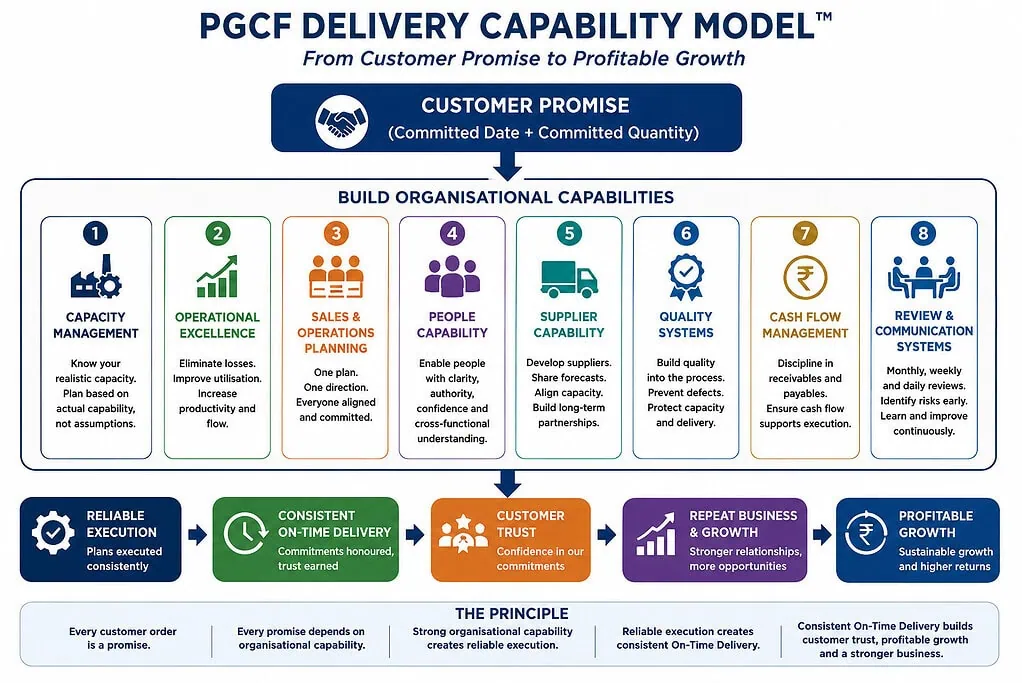
How is delivery capability connected to the Profitable Growth Capability Framework?
Delivery performance is one of the clearest reflections of an organisation’s Business Execution Capability. A company may have orders, machines and capable people, but unless demand, capacity, materials, quality, cash flow and cross-functional execution work together, customer commitments will remain unpredictable.
That is why I connect Delivery Capability primarily with the Business Execution Capability within the Profitable Growth Capability Framework (PGCF).
Stronger execution capability eventually translates into better customer confidence, more predictable business performance and profitable growth.
Summary & reflection
Every organisation wants to improve On-Time Delivery.
Before asking, “How can we improve OTD?”, ask a more fundamental question:
“Which organisational capability is currently preventing us from consistently delivering on our promises?”
The answer to that single question may reveal opportunities far beyond improving delivery performance. It may become the starting point for building a stronger, more predictable and more profitable organisation.
Building delivery capabilities is one of the CEO’s key priorities.
Wishing you a profitable growth journey in business!