
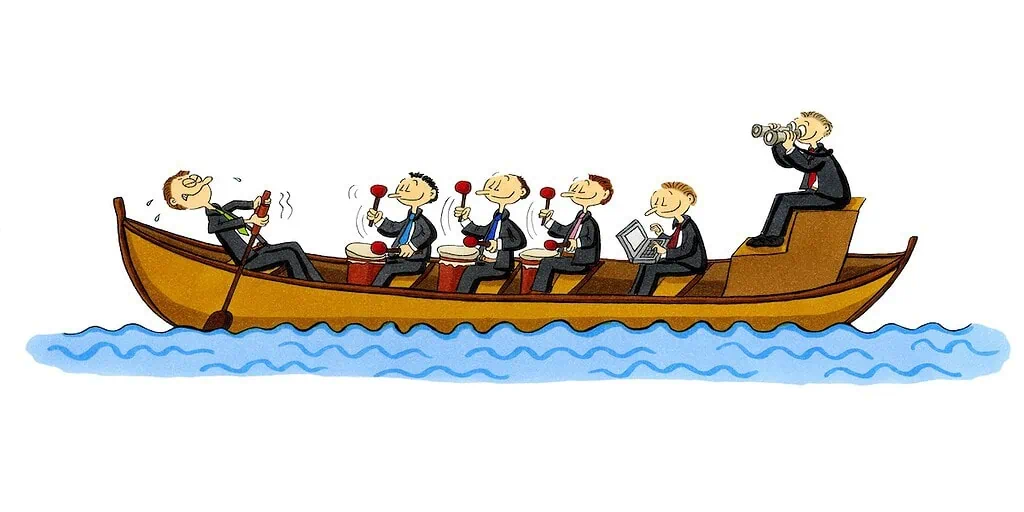
My job is done! How can CEOs build business ownership?
One concern I frequently hear from SME founders and CEOs is:
“My functional heads are technically competent. They are good at their jobs. But when it comes to achieving common business objectives, they don’t seem to think beyond their departments.”
This is an interesting challenge.
The organisation may have experienced people heading production, engineering, quality, sales and finance. Each function may be working reasonably well. Yet when an initiative requires multiple departments to work together, progress becomes slow.
Everyone is busy. Everyone has their own priorities. But who is taking responsibility for the overall business outcome?
Why do functional heads stop at their departmental boundaries?
Consider a new product development project.
The engineering head reports, “We have completed the prototype.”
That is certainly an important milestone.
But what about the production trial? Has the customer validated the product? Are the commercial requirements finalised? When will the first order be received?
The response may be, “My part is completed. The next step belongs to another department.”
Technically, the engineering head may have fulfilled the assigned responsibility.
But the business has not yet achieved its objective.
The new product was not developed merely to complete a prototype. The larger objective was to meet a customer requirement, create a business opportunity and eventually generate profitable sales.
This is where functional responsibility and business ownership begin to differ.
Functional responsibility focuses on completing an assigned activity. Business ownership requires understanding how that activity contributes to the outcome and ensuring that necessary coordination happens.
This does not mean one functional head should be responsible for everything. It means that every functional head should understand the larger objective and take responsibility for contributing to its achievement.
Why do technically competent managers sometimes lack business thinking?
In my experience, there is no single reason.
Some functional heads consciously restrict themselves to their departmental responsibilities. They believe their accountability ends once they complete their assigned work.
Others are deeply involved in day-to-day functional activities. They may not have developed the habit of looking at the larger business picture.
We should also consider how these managers have grown within the organisation.
A production manager may have been promoted for strong technical knowledge and the ability to meet production targets.
A quality manager may have been recognised for maintaining product quality and reducing customer complaints.
A procurement manager may have been appreciated for negotiating better prices.
These are valuable capabilities.
But have they been systematically exposed to profitability, cash flow, customer expectations, business growth and cross-functional decision-making?
Have they been encouraged to understand how their decisions affect other departments’ performance?
If not, expecting them to think like business leaders may be unrealistic suddenly.
There is another possibility.
Some managers may understand the larger business objective but lack the authority or organisational support to work across departmental boundaries.
Therefore, before concluding that functional heads lack ownership, CEOs need to understand what is actually preventing them from demonstrating it.
What does business thinking really mean?
Business thinking is not merely understanding financial statements or knowing the company’s annual sales target.
It is the ability to connect everyday functional decisions with customer needs, profitability, cash flow, growth, and the organisation’s long-term interests.
Consider a few examples.
Production: A production head may focus on achieving maximum output. But producing more than customer requirements could increase inventory, tie up working capital, and create storage problems.
Procurement: A purchase manager may negotiate a lower material price. But if the supplier’s delivery reliability is poor, the resulting production interruptions could cost the business much more than the purchase savings.
Quality: A quality head may insist on completing every technical validation. While quality requirements must never be compromised, business thinking also involves collaborating with production and sales to plan trials and validation without unnecessary delays.
New product development: An engineering head may complete the prototype on time. But understanding the customer launch date and coordinating the next milestone can significantly improve the chances of commercial success.
In all these situations, functional expertise remains essential.
The difference is that decisions are taken with a broader understanding of their impact on the business.
A good functional head knows how to perform the function. A business-oriented functional head also understands why it matters to the organisation.
Can functional heads develop business thinking?
I believe it can.
But it requires more than a leadership training programme.
Business thinking develops through regular exposure to business priorities, involvement in cross-functional decisions, practical learning and consistent reinforcement.
I see four stages in this development.
1. Business awareness
The functional head becomes familiar with the company’s business priorities, customer expectations, profitability and growth objectives.
2. Business understanding
The functional head understands how departmental performance influences the larger business outcomes.
For example, how production lead time affects delivery reliability, inventory, customer satisfaction and working capital.
3. Business-oriented decisions
The functional head starts considering business implications in everyday decisions, rather than focusing only on departmental targets.
4. Business ownership
The functional head proactively collaborates with other departments, anticipates risks, supports common objectives and takes initiative to achieve the desired business outcome.
This progression does not happen automatically.
The CEO and the leadership system must create opportunities for managers to develop these capabilities.
What role should the CEO play in developing business ownership?
The CEO has a significant role in shaping how functional heads think and behave.
Let us look at a few practical leadership practices.
1. Are business priorities clearly understood by functional heads?
In many SMEs, the founder clearly understands the business challenges and priorities.
The founder may be concerned about declining profitability, increasing inventory, delayed customer deliveries or insufficient new business development.
But do the functional heads share the same understanding?
For example, the CEO may be focused on improving profitability from 8% to 12%.
However, the production head may be focusing only on achieving production quantity, while procurement concentrates on purchase price reduction and sales focuses on order booking.
Unless these functional priorities connect to the overall profitability objective, the organisation may continue working in different directions.
The CEO needs to regularly communicate the key business priorities and help each functional head understand their contribution.
A useful question is:
“What should your function do differently to help achieve this business objective?”
2. Are functional KPIs connected with business outcomes?
What gets reviewed regularly receives management attention.
If functional heads are measured only on departmental performance, they will naturally focus on those measures.
For example, an engineering head may be measured on the number of prototypes completed.
But the business may care more about how many new products are successfully commercialised and how much revenue they generate.
This does not mean replacing functional KPIs with sales targets for engineering.
Instead, the organisation should establish clear functional accountability alongside shared business outcomes.
For an NPD initiative, engineering may own prototype completion, production may own manufacturing readiness, quality may own validation, and sales may own customer approval and commercial conversion.
At the same time, an identified project leader should coordinate the initiative through to commercialisation.
This brings clarity without making everyone responsible for everything.
3. Are business reviews encouraging broader thinking?
Business review meetings offer one of the best opportunities to develop business thinking.
Consider the difference between two review approaches.
The CEO asks:
“Have you completed the prototype?”
The engineering head replies:
“Yes, completed.”
The discussion ends.
Now consider a different conversation.
The CEO asks:
- Good. What is the next milestone before we can launch this product commercially?
- Has the production trial been planned?
- Are there any risks that could delay customer approval?
- What support do you need from other departments?
The purpose is not to make the engineering head responsible for every subsequent activity.
It is to encourage the person to understand the complete business process and contribute to its progress.
When managers consistently ask such questions during business reviews, they gradually start looking beyond their immediate responsibilities.
Business reviews should not merely track completed activities. They should also develop the team’s ability to achieve business outcomes.
4. Are functional heads given opportunities to work across departments?
Business thinking improves when managers are exposed to challenges outside their immediate functions.
For example, consider an initiative to improve on-time delivery.
The production head alone cannot achieve the desired improvement.
Sales must provide reliable demand information. Planning must establish realistic schedules. Procurement must ensure material availability. Maintenance must improve equipment reliability. Quality must support timely clearance.
When functional heads work together on these initiatives, they begin to understand the interdependence between functions.
The CEO can encourage this by selecting a few important business improvement projects and assigning clear cross-functional responsibilities.
These projects become practical opportunities for developing leadership capability.
5. Is the CEO empowering managers to make business decisions?
This is an area where founders may need to reflect on their own management practices.
Sometimes CEOs expect functional heads to demonstrate business ownership but continue making most cross-functional decisions themselves.
Whenever two departments disagree, the matter immediately reaches the CEO.
Over time, managers may become comfortable escalating problems rather than working together to find solutions.
If we want functional heads to develop business thinking, they need opportunities to evaluate options, understand trade-offs and make decisions within clearly defined authority.
The CEO should guide and coach them, rather than automatically providing every answer.
For example, instead of immediately deciding how to resolve a delivery problem, the CEO can ask:
- What options have you discussed with the other functions?
- What are the implications for the customer, cost and delivery?
- Which option do you recommend, and why?
Such conversations develop judgement and confidence.
How can SMEs begin developing business ownership?
I would suggest starting with a few practical steps rather than launching a large organisational development programme.
First, identify three to five important business outcomes
These could include improving profitability, increasing on-time delivery, reducing inventory, accelerating new product commercialisation or improving customer retention.
Second, connect functional responsibilities with these outcomes
Help each functional head understand how their decisions and actions influence the selected business priorities.
Third, select two or three cross-functional improvement initiatives
Assign one accountable leader for each initiative, with clear milestones, functional contributions and review mechanisms.
Fourth, introduce business-oriented questions into regular reviews
Move beyond activity completion. Discuss business impact, upcoming milestones, risks, interdependencies and decisions required.
Fifth, recognise business-oriented behaviour.
Appreciate managers who proactively coordinate with other functions, anticipate problems and contribute to shared results.
These practices need to be followed consistently.
The objective is not to make every functional head behave like a CEO. It is to help them become stronger business leaders within their respective areas of responsibility.
How can CEOs recognise that business ownership is improving?
The change may first show up in everyday conversations and behaviours.
A production head begins discussing customer delivery requirements rather than only production quantities.
A procurement head considers inventory and cash-flow implications while negotiating purchases.
An engineering head proactively coordinates the next milestone after the prototype is complete.
Functional heads begin discussing possible solutions with one another before escalating every issue to the CEO.
During business reviews, managers start presenting risks, options and recommendations rather than merely reporting completed activities.
These are encouraging signs.
Over time, such behavioural changes should also contribute to better execution, faster decisions, stronger customer delivery and improved business performance.
However, behavioural change needs clear responsibilities, appropriate authority, and a consistent review system.
Are we expecting business ownership or consciously developing it?
Functional expertise is essential for running a business effectively.
But as an SME grows, functional excellence alone may not be sufficient.
The organisation needs leaders who can connect their functional responsibilities with larger business objectives and work together to achieve them.
Some managers may develop this perspective naturally. Others may need greater exposure, coaching and opportunities to practise it.
The CEO has an important role in creating that environment.
By repeatedly communicating business priorities, connecting functional KPIs with common outcomes, encouraging cross-functional working and asking better questions during reviews, CEOs can gradually develop business thinking among their functional heads.
The real shift is from “I have completed my job” to “How can I contribute to achieving the business outcome?”
And that shift begins with how the organisation is led.
A question for SME founders and CEOs:
Are we consciously developing business ownership among our functional heads, or are we simply expecting them to think like business leaders?